Showing posts with label horror history. Show all posts

Friday, May 17, 2013

Room 237: When the Director Haunts the Audience


After watching Room 237, my perception of ghosts has changed.

Room 237 is a documentary in which theorists and experts of Stanley Kubrick's The Shining share their findings concerning hidden messages in the mise en scene of the film. The Shining is already terrifying on the first watch. It is undeniably tense, and creepy, and gory. In the next watching of The Shining one might notice more creepy details; a notable turn of phrase, color themes, a missing piece of furniture.

The folks from this documentary studied The Shining meticulously. Their continuity errors and coincidences turned into theories about hidden messages from Kubrick. The messages and symbolism he hid in the film are like ghosts in and of themselves.

Repeated Native American imagery hints that they were the ghosts haunting the Overlook Hotel. "We built it on an Indian burial ground." Where have I heard that before?

A movie about a haunting is scary on the first viewing because of the surprise elements, but if there is something new to notice in the next viewing that can rekindle the same fear. It causes one to question what is perceivable. What am I missing? What demon was right behind me and I didn't notice?

This is what you get when The Shining is played backwards and forwards at the same time.

Kubrick's added touches (whether he meant them or not - but he probably did) make the avid viewer witness to a real haunting. It is a haunting of the audience by the director. The director is communicating with the audience as a ghost would to it's haunted; without words. He does it with continuity errors in the furniture, things out of place, subtle hints in the shapes of props, the colors characters wear.

Kubrick 1. was very secretive, 2. detail-oriented to say the least and 3. is dead, making these hints literal messages from beyond the grave.

Someone thought the hotel manager got a ghost boner when he shook Jack's hand. While it is undeniable, I'm not sure why it's important.

I know I'm not alone in saying that documentaries such as Room 237 are thrilling. Once you thought you saw The Shinning too many times to be scared, the people in these interviews inject more "ghosts" into it. The most interesting part is that we all know it's just a movie; the ghosts haunting the Overlook Hotel are fictional. Kubrick's hidden messages are not actually scary ghosts, yet hearing about his sly trickery, his subliminal mind teasers, will give you chills. This is because people like to be in control. That's why ghosts - if they exist - are scary; you never know when they will strike, how they will show themselves, and to what severity it will effect you. A powerful and genius director such as Kubrick has power over his cast, set, and audience, with the way he chooses to withhold and dispense information. We continue to find the specters of his cinematic message to this day.

Still, no one in the documentary explained this...

Thursday, October 4, 2012

Fake Cannibalism / Real Cannibalism

I haven't posted for a while, but I figured I'd come back with a bang. Right now I'm going through a bout of writers block, as well as photographer's block. The funny thing about life though, is every so often something lurks about and finds it's way to inspire you. Just like when I went to the Golden Gate Bridge and was reminded of the chilling documentary, The Bridge, in seeing this BuzzFeed post on gorilla marketing for Resident Evil 6, I was reminded of a VICE documentary about Issei Sagawa.

In case you don't know about the food sculptor Sharon Baker and her installation in the Smithfield meat market East London, or Issei Sagawa, here is a visual.


The "Human Flesh Meat Market" looks quite upsetting. I think the flesh is made of Prosciutto. Not sure what the fingers and other "offal" are comprised of.
I had a familiar feeling when seeing images of this installation. I am very sensitive to bodily integrity (not to be confused with BIID in which case I would want to cut my arm off), so seeing dismemberment creates feelings of dread and way too many introspective thoughts; like how much less of myself would I be without these limbs? It was similar to when I first saw the black and white images of Issei Sagawa's victim.

Issei Sagawa is a Japanese man, who in 1981, killed and ate part of a young Dutch woman in Paris. Sagawa was detained in a mental institution, declared insane, and shipped back to Japan after the French public expressed outrage of Sagawa's detainment at their expense. Then he appeared to slip through the cracks of the justice system.

 VICE made a short documentary called VICE Meets Issei Sagawa, in which we see Sagawa free as a bird living in Japan, though seemingly trapped in a personal hell. Sagawa explains how cannibalism began as a form of sexual desire as a young boy that escalated into adulthood. While Sagawa claims to attempt remorse to no avail, he simultaneously expresses extreme guilt for being alive, surmising he must be some kind of alien; an abomination.

After Sagawa came back from Paris, his only means of income involved capitalizing on his bizarre crime. Sagawa goes as far as to say "Japanese people nowadays are really stupid" speaking about how he has been asked to write books, make art, and pornography, all exploiting the horrific nature of the incident.  Even he understands the depravity of this. What is most disturbing are the videos film makers made of him, making a freak show of his mental issue, making his cannibalism a sick joke, rewarding his irregularity, and concurrently disregarding the gravity of life lost at his hands.

In Vice Meets... you get a glimpse at a pornographic video in which a Japanese adult film actress interacts with Sagawa (he does not eat or harm her), ending with a tearful interview as she reflects on learning of his crime and obsessions. You will be happy to know that even after such an experience this woman has continued to be a "good friend" to Sagawa. I cannot understand her courage, or her motives.

Below is part 1 of VICE Meets Issei Sagawa. This video is NSFW. It is extremely graphic on many levels.

Monday, April 30, 2012

Third Reich: The Rise & Fall

If you ever thought you had absorbed all there was to learn and see about Germany during Hitler's rule, think again. This ain't no Ken Burns documentary.  If you love film, photography, and history, you must watch Third Reich: The Rise & Fall.

 A 2010 two part miniseries directed by Nicole Rittenmeyer and Seth Skundrick, Third Reich uses propaganda films, historical documentation, and most importantly, home movies and smuggled footage that has never been viewed in America, or that is still banned in Germany. Rittenmeyer and Skundrick also directed my favorite 911 documentary, 102 Minutes That Changed America, a documentary entirely using the personal footage and rare news footage of the Twin Tower attacks, composed in real time, starting moments before the first plane hit, and ending as the last tower fell. Much in the style of revered nuclear bomb documentary, Atomic Cafe, there is no narrative, except the voices behind the cameras. If you are a fan of either Atomic Cafe or 102 Minutes, Third Reich has a similar use of found film, though unlike the other two, there is a narrator and voice-overs of diary entries and letters.

It is also exciting to see so much color footage in this WWII documentary. Color film did exist in the 1930s, though expensive and rare, seeing the people and destruction in living color brings it to a reality that I have yet to become jaded over. Black and white causes a separation; today it is a stylistic choice and an understood limitation of the past, so there is an undertone of stoicism in every image. Color images taken during time periods we most associate with black and white are the most compelling and relatable.

The home movie footage adds a soul to the German people, that is not often seen in WWII documentaries. It is easy to get used to documentaries that rely on interviews and re-use footage and images whenever possible. Third Reich breaks all the expectations. Aside from the expected images of death, scenes like the home movie footage of a soldier's autobiographical puppet show/pyro fantasy are particularly disturbing. Ranging from endearing family moments to shockingly grizzly scenes of death, Third Reich is so intimate and candid, you are constantly left amazed at what you behold. 


Tuesday, February 21, 2012

Guided Tour as Documentary: Six Degrees of Helter Skelter

Helter Skelter: The True Story of The Mason Murders  has the best opening line in a book I've ever read:

"It was so quiet, one of the killers would later say, you could almost hear the sound of ice rattling in cocktail shakers in the homes way down the canyon."

This is the kind of opening line that lets you know you're not going to put the book down. Written by Vincent Bugliosi, prosecutor during the Manson trials, the novel follows the Manson Family and their victims in exquisite detail, leading them into their final collisions.

Though, this isn't about the book, Helter Skelter. This is about the 2009 documentary Six Degrees of Helter Skelter, which explores the actual sites of the crimes committed by, and residences of the Manson Family.

The film starts unfortunately, with an opening line that let me know I was going to be disappointed. The dictionary definition of helter skelter is cited, and then juxtaposed this with what the narrator deemed would be Charles Manson's definition: "The end of the world brought on by the Beatles."

I could not believe that within the first 7 minutes of a documentary there would be such blatant misrepresentation of facts. In a nutshell, Manson did believe the Beatles knew about the end of the world, which he called "Helter Skeleter," but he did not believe that they were the ones "bringing it down." Helter Skelter was what Manson believed to be an inevitable race war.  For an unabridged explanation of Manson's interpretation of Helter Skelter, click here.


The whole documentary is lead like a Hollywood tour. That is because Six Degrees of Helter Skelter was directed by and stars a Hollywood tour guide, Dearly Departed Tours owner, Scott Michaels. This fact is made abundantly clear during the first 15 minutes of the film, which are devoted to Michaels' life story and proud show-and-tell of his morbid Hollywood memorabilia collection.

Michaels claims his legitimacy in the film by taking some time to besmirch other tour guides with his concept that a guide's own desire to be a famous actor is inversely proportional to how many facts they get right. Not a good argument to start with considering the evidence of Michaels' ego so far. The constant flow of hearsay, was irksome. Even facts that matched up to Bugliosi's novel were peppered with lines like, "I knew a guy who," and "I heard [insert famous actor] claims this."

Overall it was amateurish and masturbatory. Michaels didn't bother to re-record or cut out any of his stammering, or cute lines like, "I got my GPS bitch in the box thing." Most shots were of him walking to and fro the alleged crime scenes.  He was name-dropping like crazy, and only two people were interviewed. So much for all those guys he knows.

There are a few positive moments to note. Michaels used full color uncensored crime scene photos, and had video footage from Trent Reznor's stay at the Cielo Drive house. Recordings of Manson's songs were also played during the film, which were haunting, especially a song sung by the women of the Manson Family.

If you don't know much about the Manson Family murders, watch this film, but be forewarned that there is much more to know than what is presented. If you have ever read Helter Skelter, any other Manson related books, or seen any other Manson documentaries, watch Six Degrees of Helter Skelter for the crime photos, Reznor footage, and Manson music, but that's all that you will gain.

It is a neat concept to be taken to these crime scenes as a true to life alternative to a classic stuffy documentary. However, the novelty wears thin when you realize you aren't really there; you're watching a documentary. As tours go, it's pretty enthralling, but as documentaries go, it's a C+ at best.

Sunday, August 28, 2011

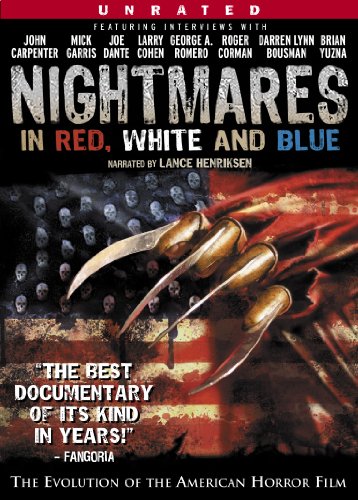
Nightmares in Red White and Blue

Have you ever recalled one of your dreams and really analyzed it? Did you gather all the elements and realize that they represented deeper desires and fears you have in the material world... and that you are really f'ed in the head?
We could say from looking at what America has produced in cinema, that America has it's own collective conciousness. America's hopes and fears are fairly obvious up front, but when America dreams and makes art, something very scary comes out.
Nightmares in Red, White and Blue is an excellent documentary for the horror buff, history buff, and anyone asking the question, "Why the heck are American's obsessed with violence?"
If you enjoyed Bravo's The 100 Scariest Movie Moments (one of my top favorite countdown shows!) you will love Nightmares. You see the evolution of the horror movie genre shaped by social upheavals, changes in standards, politics, and most importantly, war.

Psychologically, we see the movie monsters alter to society's changing fears.  In 1910 Thomas Edison made a film adaptation of Mary Shelly's Frankenstien. A decent attempt at adapting a novel to film, it was a failure in theaters. It wasn't until after The Great War (WWI), when men were coming back injured and deformed like from no other war in history, film makers responded with the horror genre. They made their "monsters" mortal men who were hideous and cast aside by society, their ill fate causing them to be bitter and evil.

Nightmares explains how each decade's events, events that shapped the American psyche, were latently placed in horror movie topics, such as foreign evil-doers, body snatching, atomic insects, zombies, etc. Post Manson murders (and the end of the hippie era in general) gave way to extreme sexual blood lust movies, films about gangs of murderers senselessly terrorizing good people, and movies about the occult.

You thought that the b-movies, exploitation and slasher films were just mindless fun, but like the rings in a tree trunk, they reflect our own history back to us. So you sit down with America. Because you love America, you read between the lines of their dream journal and say,
"America, that's some heavy stuff. I think you might be paranoid about communists, have ptsd from the war, and were disenchanted by how the hippie movement went. Maybe you should talk to someone... Pft! Who am I kidding!? Repression is the backbone of these films. Get off on the blood and violence, or enjoy the allegory, who really cares? You got a good thing going America, don't change."