Showing posts with label violence. Show all posts

Monday, June 23, 2014

A Fire You Can't Put Out

"This process is necessary to prevent such a terrible thing to ever happen again."

- Philadelphia Special Investigation Commission Chairman William H. Brown III, 1985

Being nostalgic for the 90s is what people do now, and I'm no exception. I was 6 in 1993, so I was somewhat aware of the news but definitely not all the shady details. The ESPN 30 for 30 documentary by Brett Morgan called June 17th, 1994 is amazing to watch if you know about the white Bronco chase with OJ Simpson, but didn't know it was one of the biggest days in sports history. Seriously - so many things were happening that day and history was being made, but OJ really cluttered up the news. It's a superb documentary, and the kind where the director lets the found footage do all the talking - which is my favorite style of documentary - but this isn't about June 17th, 1994. 

That doc about the 90s spurred me on to watch a doc about another event that happened in my lifetime, but was too young to understand. I started searching for Waco.

Director: Wiliam Gazecki 1997
On YouTube I found Waco: The Rules of Engagement. Directed by , the film mostly conveys an anti ATF stance, where footage and phone conversations between the cult group, the Branch Davidians, and the FBI show that the US government ruthlessly attacked women and children in the name of suppressing a group that was stockpiling weapons. During the 51 day siege, there were disputes over who fired the first shot, the ATF insisting one of the Davidians fired first, prompting the incessant teargassing and machine gun fire that would eventually set the compound ablaze and kill 76 people.

While the leader David Koresh was infamous for allegations that he was sexually abusing young female followers, certain scenes from the subsequent trial, implied that discussion about the sexual perversions of David Koresh were considered a diversion from the serious transgressions of the ATF. For instance, the ATF's defense brought in a witness who was molested by Koresh years before when her family was in the cult. While her testimony was tragic the prosecution questioned the relevance and reminded the defense that despite what David Koresh may have done to those poor people, the ATF was still under fire for possibly contributing to the effective execution of those individuals who were victimized by Koresh as they described. This thorough film makes a point to stay on track and focus solely on the siege and it's aftermath.


 With this still fresh in my mind, I searched Netflix for similar fare, and the title Let The Fire Burn caught my eye.

Director: Jason Osder 2013
As it turns out, eight years earlier, another group considered to be a cult, was burned alive in their compound. This time, it took place in West Philadelphia. It's 1985, Mother's Day, and the Pennsylvania State Police are once again after the black liberation / back to nature cult, the Move Organization. Move was thought to have stockpiled fire arms, in addition to creating dozens of complaints from neighbors concerning building codes and aggressive behavior. They, like the Davidians, experienced a siege. Theirs only lasted 24 hours, but managed to destroy 60 homes in a dense neighborhood. Only two people in the Move house survived.

Much like Waco, the facilitators of the siege were taken to court over the validity of the force and fire used to vacate the people of Move from their house; a force that appeared to be an outright murder rather than an evacuation.

It is disheartening to know that something like this would happen over again, and I wonder what other instances of this escalation have happened or could be currently happening.

This is a venn diagram of how the Waco siege and the Move siege held many similarities.
The opening quote spoken by William H. Brown III is from court room footage in Let The Fire Burn. The "process" he describes is the thorough interviews and testimonies given by the police, the remaining and former members of the cult organization in question, and the innocent civilians who were affected. All sides believed themselves the victims in some aspect, and it was important to hear all sides to find justice.

The similarities of this incident to Waco struck me, but I believe the Move siege appeared to have affected many more people who had nothing to do with Move or the Philadelphia police. On the one hand the neighbors did want to see Move, well, move. On the other hand the police wanted to smoke out 11 people from one building so badly 60 homes were destroyed in the process. While the citizens had negative testimonies concerning Move's relationship to the community, they were rightfully up in arms over how the Philadelphia police handled the situation.

Between the two documentaries Let The Fire Burn was my favorite. Waco: The Rules of Engagement
was informative, but very long, clocking in at over 2 hours. As mentioned earlier, I really enjoy a documentary that can convey it's message without talking heads or narration in the traditional sense, and Let The Fire Burn was successfully made in that style. Footage from local news stations of that fateful day are interwoven with segments of a student documentary from the 1970s about Move, and video of the court proceedings with some captions, but no narration whatsoever. It gives you a sense of the time period and the emotions flowing behind every viewpoint. It speaks to all sides of the story and attempts at purveying the truth.

Saturday, August 3, 2013

To Build and Walk Away:The Pruitt-Igoe Myth


Pruitt-Igoe contained an amount of negative space that once witnessed and understood evoked feelings of dread. I didn't know I was looking at the Pruitt-Igoe apartment complex when first watching the segment in Koyaanisqatsi in which a series of unkempt apartment complexes are shown in sweeping areal shots. I had seen large apartment buildings before, nothing seemed awry. When the shots come in closer, and it was apparent that the buildings were lifeless empty shells, the horror becomes clear. Every window was broken, like there was an effort put into Pruitt-Igoe's special appearance: just enough damage to convey everything bad in this world, while still being able to stand. How could this have happened? It was like a carcass lying in the open. 

Before it was demolished in the 1970s, Pruitt-Igoe was supposed to be a turning point in the socioeconomic heath of St. Louis, MO. A modern public housing project conceived during the 1950s that would provide low-income families with apartments that were dream homes compared to the slums they were familiar with. It consisted of 33 11-story apartment buildings, which was one of the largest complexes in the USA at the time. It was advertised as a utopia, or more realistically, a clean civilized place that would promote idealist white civilized behavior, or even more realistically, a place to segregate the poor black population; a band-aid.

The St. Louis government paid for the construction, but failed to pay for the upkeep of a massive ecosystem they didn't understand. The documentary The Pruitt-Igoe Myth, directed by Chad Freidrichs, investigates the factors that lead to the devastation; a problem even larger than the original slums they were trying to eradicate.

The Pruitt-Igoe Myth uses heartbreaking footage of the apartments as well as interviews with former tenants. It is shocking how disparate their memories of Pruitt Igoe are; from the joys of their first Christmas out of the slums, to family members brutally murdered in the playground. The intentions of the St. Louis housing authority begin to get hazy as the film goes on. Some who are interviewed described the complex as a prison. Living in Pruitt-Igoe was supposed to be an opportunity, but it came with a price. There were regulations that prohibited "able-bodied husbands" from living there, effectively breaking up families so wives and their children could qualify to live there. Telephones and televisions were prohibited also. All of this lead to overwhelming feelings of isolation. And while young children were taught to fear the white men in suits who regularly checked homes to be sure their fathers were appropriately absent, there was a total lack of regulation in keeping the buildings safe from criminals, fire, and filth. It was doomed from the start to keep everything good out and drag complete negativity in, until it literally had to be imploded.

Monday, April 30, 2012

Third Reich: The Rise & Fall

If you ever thought you had absorbed all there was to learn and see about Germany during Hitler's rule, think again. This ain't no Ken Burns documentary.  If you love film, photography, and history, you must watch Third Reich: The Rise & Fall.

 A 2010 two part miniseries directed by Nicole Rittenmeyer and Seth Skundrick, Third Reich uses propaganda films, historical documentation, and most importantly, home movies and smuggled footage that has never been viewed in America, or that is still banned in Germany. Rittenmeyer and Skundrick also directed my favorite 911 documentary, 102 Minutes That Changed America, a documentary entirely using the personal footage and rare news footage of the Twin Tower attacks, composed in real time, starting moments before the first plane hit, and ending as the last tower fell. Much in the style of revered nuclear bomb documentary, Atomic Cafe, there is no narrative, except the voices behind the cameras. If you are a fan of either Atomic Cafe or 102 Minutes, Third Reich has a similar use of found film, though unlike the other two, there is a narrator and voice-overs of diary entries and letters.

It is also exciting to see so much color footage in this WWII documentary. Color film did exist in the 1930s, though expensive and rare, seeing the people and destruction in living color brings it to a reality that I have yet to become jaded over. Black and white causes a separation; today it is a stylistic choice and an understood limitation of the past, so there is an undertone of stoicism in every image. Color images taken during time periods we most associate with black and white are the most compelling and relatable.

The home movie footage adds a soul to the German people, that is not often seen in WWII documentaries. It is easy to get used to documentaries that rely on interviews and re-use footage and images whenever possible. Third Reich breaks all the expectations. Aside from the expected images of death, scenes like the home movie footage of a soldier's autobiographical puppet show/pyro fantasy are particularly disturbing. Ranging from endearing family moments to shockingly grizzly scenes of death, Third Reich is so intimate and candid, you are constantly left amazed at what you behold. 


Sunday, August 28, 2011

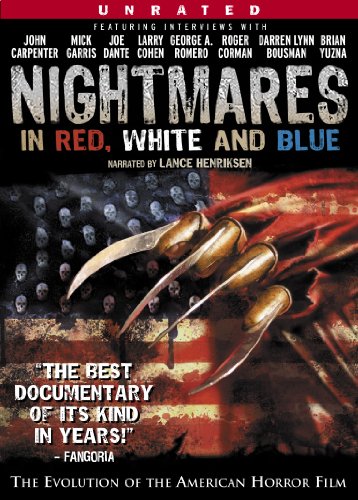
Nightmares in Red White and Blue

Have you ever recalled one of your dreams and really analyzed it? Did you gather all the elements and realize that they represented deeper desires and fears you have in the material world... and that you are really f'ed in the head?
We could say from looking at what America has produced in cinema, that America has it's own collective conciousness. America's hopes and fears are fairly obvious up front, but when America dreams and makes art, something very scary comes out.
Nightmares in Red, White and Blue is an excellent documentary for the horror buff, history buff, and anyone asking the question, "Why the heck are American's obsessed with violence?"
If you enjoyed Bravo's The 100 Scariest Movie Moments (one of my top favorite countdown shows!) you will love Nightmares. You see the evolution of the horror movie genre shaped by social upheavals, changes in standards, politics, and most importantly, war.

Psychologically, we see the movie monsters alter to society's changing fears.  In 1910 Thomas Edison made a film adaptation of Mary Shelly's Frankenstien. A decent attempt at adapting a novel to film, it was a failure in theaters. It wasn't until after The Great War (WWI), when men were coming back injured and deformed like from no other war in history, film makers responded with the horror genre. They made their "monsters" mortal men who were hideous and cast aside by society, their ill fate causing them to be bitter and evil.

Nightmares explains how each decade's events, events that shapped the American psyche, were latently placed in horror movie topics, such as foreign evil-doers, body snatching, atomic insects, zombies, etc. Post Manson murders (and the end of the hippie era in general) gave way to extreme sexual blood lust movies, films about gangs of murderers senselessly terrorizing good people, and movies about the occult.

You thought that the b-movies, exploitation and slasher films were just mindless fun, but like the rings in a tree trunk, they reflect our own history back to us. So you sit down with America. Because you love America, you read between the lines of their dream journal and say,
"America, that's some heavy stuff. I think you might be paranoid about communists, have ptsd from the war, and were disenchanted by how the hippie movement went. Maybe you should talk to someone... Pft! Who am I kidding!? Repression is the backbone of these films. Get off on the blood and violence, or enjoy the allegory, who really cares? You got a good thing going America, don't change."