Thursday, October 15, 2015

The Double: With Triple Analysis


The Double (2014) directed by Richard Ayoade, (the British actor you might know best from the famous Fire! video clip) is a visually stunning film that manages to be quirky without being cliche, and unique while harkening to past films. The flavors I detected within The Double came from The Hudsucker Proxy (1994), Eraserhead (1977), and Fight Club (1999). All films deal with themes of feeling like an outsider, the modern industrial wasteland, the corporate grind, the cruelty of bureaucracy, alter egos, being a fraud, and suicide.  

[SPOILERS AHEAD]
 

Hissing smoke, the distant clunking sound of metal on metal, a train horn in the distance. All dear and familiar sounds...

Within the first few minutes of The Double, I concluded that it was a technicolor Eraserhead

The awkward man clad in a suit makes his way through a barren industrial landscape to a sad studio apartment. It's perpetually night, and any daylight is suffocated by modern encasings. There is little to be enjoyed in this universe. The Double has Simon James (), who likes to watch one TV show about a strong, rough man. Eraserhead has Henry Spencer (), who looks at his radiator and dreams of a pure happy woman in a Vaudeville style act. 


There's something decidedly timeless about the universe they live in. Somewhere wavering between the 1950s and the 1970s, industry and machinery rule, and a formal approach to dress keeps characters rigid and conformed. The mechanical equipment in both films are unidentifiable but vaguely familiar. They are metal, have buttons and lights, produce items, but their function is based on fantasy.

The people they encounter are hostile. The protagonist just can't catch a break. No matter how meek, submissive and nonthreatening, he is berated, belittled and steamrolled - most notably by older women.


The films are both padded with elderly characters that contrast the youthful protagonist, but mirror his feebleness.  


He is in love with a young woman, but she doesn't love him back in the same way.


Her approval is just out of his grasp. In The Double, Hannah () is the victim of two extremes in male behavior, which Simon has the ability to execute (whether he knows it or not). Simon watches Hannah from afar, silently hoping to gain a connection. In an anecdote about a man who committed suicide in her building, Hannah explains that she is unnerved by this style of courtship - which he is guilty of himself. Simon's alter ego, James Simon, harms Hannah in a more aggressive way: loving and leaving, cheating, and even slapping her in an argument. Hannah attempts suicide and miscarries James's child. Simon James and James Simon are opposites, but both still land outside the spectrum of suitable. 


In Eraserhead, Mary X () finds herself indelibly tied to Henry by their illegitimate and deformed child. Mary is thrust into motherhood, living with Henry in his cramped apartment. The stress of raising this ill infant, who she can't recognize as her own, causes Mary to move out. Henry's meek spirit doesn't exactly encourage her to stay.  

Simon and Henry's romantic exploits are met with ridicule and embarrassment.


Even the elevators are cruel.


At least Henry is "on vacation." Eraserhead is already saturated with quintessential nightmare versions of everyday life; the Eraserhead workplace would be bleak and torturous on Jheronimus Bosch levels. Maybe we get a glimpse of this at the pencil factory - where Henry's disembodied head is sold to make erasers. 

Both Simon and Henry's stories end with their heads smashed on the pavement, and their spirits being taken to Heaven by people who truly understand them. More on that later...

 
The Hudsucker Proxy and The Double have their tones set by suicide early on. Simon is going about his usual routine of spying on Hannah across the courtyard, when he sees a man pirched above her apartment staring back. Suddenly he's dropped. The tragedy brings Simon and Hannah together as neighbors and co-workers. 


Waring Hudsucker, the founder and president of Hudsucker Industries, commits suicide by jumping out of the skyscraper window during a meeting. Knowing Hudsucker's stock shares will be sold to the public, board member Sidney J. Mussburger (Paul Newman), schemes to buy the controlling interest in the company and temporarily depressing the stock price by hiring an incompetent replacement. Norville Barnes (Tim Robbins) a lowly mail room clerk on his first day, comes to deliver a letter to Mussburger, but decides instead to pitch his invention of a simple circular toy. Believing Norville to be the right idiot for the job, Mussburger immediately promotes him to president. 


Is he a fraud?
Simon James is irked by the presence of a new employee named James Simon. It's like looking into a mirror, but no one seems to notice but Simon James. There's something about James that's so charismatic, he can get away with murder. James impresses with minimal effort. He lies and cheats on a psychopathic level. On the other hand, there's something so unremarkable about Simon, that he seems to be a "non-person." Simon's malfunctioning work ID causes him to be shut down on a bureaucratic level. If the ID doesn't work, you aren't in the system, and if you aren't in the system, you don't exist. The system is uncaring and exclusive, though it is run by humans.


The Hudsucker Proxy captures the insanity of bureaucracy as well. It's comical in it's absurdity, yet recognizable. My favorite scene from Hudsucker is the one pictured above right. It's Norville's first minutes in the mailroom, and he's being screamed at by a supervisor. Without warning the man rattles off, "6787049A/6. That is your employee number. It will not be repeated! Without your employee number you cannot get your paycheck." The rest of the quote can be found here


Work can feel this way at times; designed for automatons and not humans.

Simply on the basis of premise, The Double and Fight Club share the same story. A young man, fried by the corporate machine, splits into a second persona whom he believes to be his savior and also his tormentor, only to find that they were one in the same person.


The young man does not live his life to the fullest, he might be categorized as a nerd. The alter ego is the exact opposite. He is suave, and has good luck with women. He has the answers to everything, and seems to move smoothly through life by his wits. By all accounts this mysterious man is a jerk who should be punished and not praised for his behavior, but the prevalent theme appears to be "nice guys finish last."


Through bouts of self-harm, culminating in a suicide attempt, the alter ego is freed.

The main difference is that the alter ego in Fight Club, Brad Pitt's Tyler Durden, looks nothing like Ed Norton's character (simply called "The Narrator"), while Jessie Eisenberg plays both characters, as Simon James and James Simon. This creates a comically surreal nightmare scenario where the sanity of every other character is questionable. That anyone would believe these men were not twins or even see a resemblance between them is outlandish, but this is Simon's lament.

It's unclear in Fight Club if anyone besides the Narrator sees Tyler Durden as a separate person. This allows the charade to hold up, but ultimately lays the foundation for them to plausibly be the same person. Unlike The Double, Fight Club's Narrator is the only one who sees his alter ego as another individual, while we imagine the reality would involve the Narrator switching personalities as he interacts with people, and talking to himself a lot. The Double rides this line. There are many scenes where Simon confronts James to the point of revealing that he's an illusion. However, the rest of the characters are so certain that they are different men, Simon is left defending his personality, and attempting to prove that they are the same. The Double is part scifi fantasy, part psychological case study.


The suicide attempt by The Narrator in Fight Club is ultimately nonfatal, but the gun shot to the cheek appears to rid him of Tyler Durden. The suicide concluding The Double is most likely fatal, but left to our imagination. Simon is loaded into an ambulance after jumping from his apartment window, while James dies from the injuries as he is restrained inside the apartment. Simon appears alert, and Hannah is inside the ambulance. A happy ending seems likely. Then the Colonel (the owner and idol of the company Simon works for) appears in the ambulance with them.


In The Hudsucker Proxy, Norville almost falls to his death from his skyscraper, but is saved by a supernatural force, and visited by the angelic apparition of Waring Hudsucker. Near death, Norville and Simon are both visited by the beloved god/bosses of their respective employers. 

In the ambulance the Colonel comments that Simon is a special person. His untimely presence and encouraging tone is unsettling, considering the circumstance. It is then we realize the ambulance ride is most likely a heavenly dream.

At least Simon gets to go solo.


Thursday, July 30, 2015

Check Dune Off My List

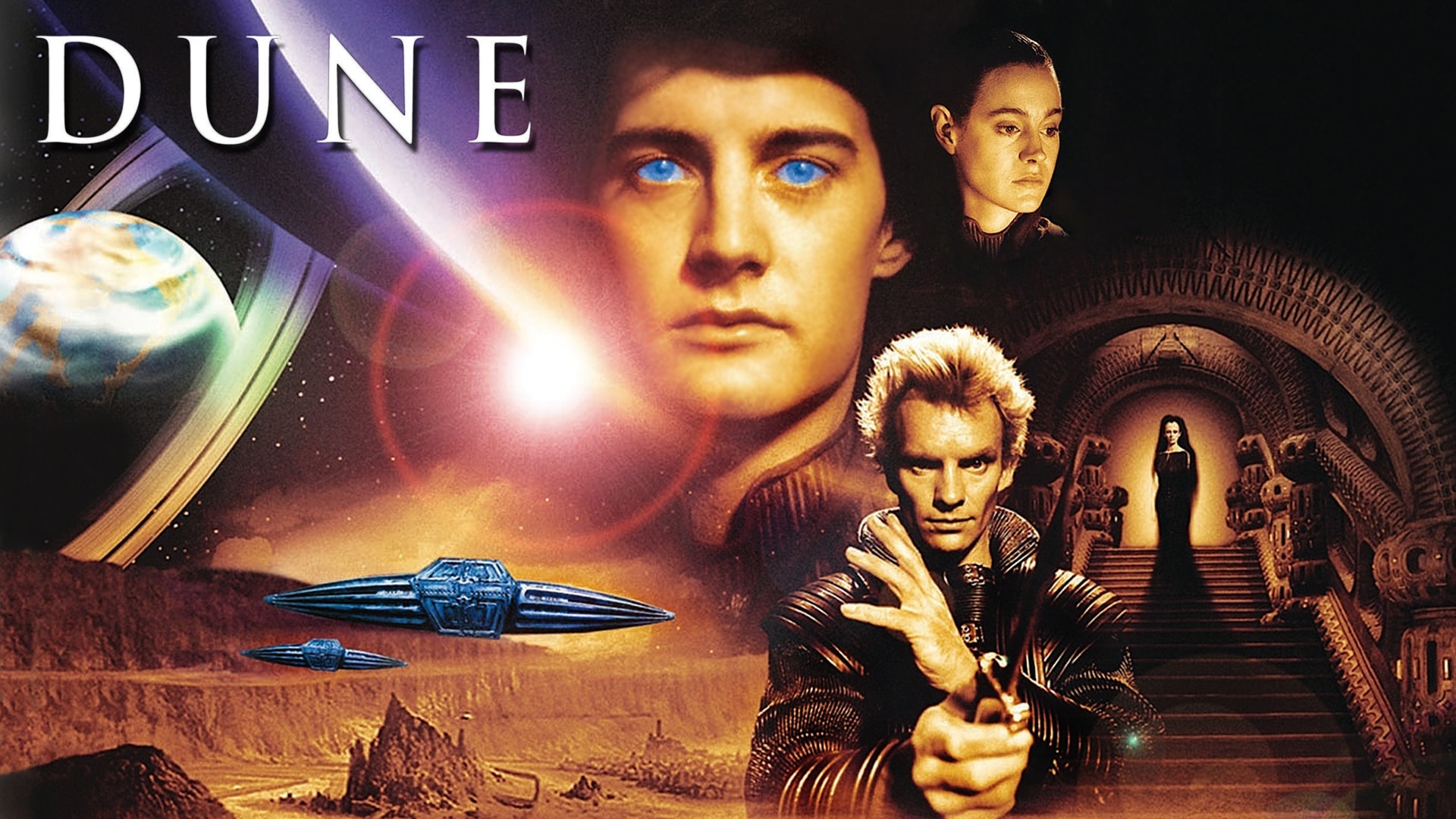
I finally saw Dune. Finally. Some might ask how I could have put it off this long, being such a big David Lynch fan. Others might say, "Oh... isn't that supposed to not be so good?"


It was something. But more on that in the conclusion.

My personal excuses for not watching were:
1. Indeed never hearing anyone say it was good.
2. Being a cheapo who doesn't like to pay (upfront) for movies anymore. (Dune is not on Netflix or Hulu Plus).
3. A fear of watching David Lynch do an adaptation instead of an original story, because it might be void of soul and a waste of time.

For some mislead reason, I felt as though Lynch's adaptations would be something he did for money; paying his dues before he could break out and make another movie like Eraserhead. However, after seeing The Elephant Man - based on a book of the same title - it was clear that it was possible for Lynch to make an adaptation all his own.

David Lynch is as David Lynch does.
 Read this article I wrote if you want to hear about what I gleaned from The Elephant Man.

I decided to give Dune a try after seeing the YouTube video Lost In Adaptation: Dune. I'm a jerk to myself when it comes to spoilers, so having not read the novel by Frank Herbert, nor seen the movie, my interest was piqued. The video was created by The Dom, who has a series called Lost In Adaptation, in which he reviews movies compared to their paper counterparts. This series has the perfect balance of comedy and insightful analysis. I enjoyed watching several of them, including The Shining - which I adore as a film, and may actually read thanks to The Dom.

The Dom joked about how the below shots were not only inaccurate to the book, but also completely f#%ked.

Seems legit

Meanwhile, I was thinking: Dune where have you been all my life?! This kind of imagery convinced me David Lynch actually directed Dune. Maybe it wasn't neutered after all. Prepared to see the film, I went in knowing that this was not the most loyal adaptation of the book. That only made me more excited to see how Lynchian Dune truly was.

Since Dune was book-ended by The Elephant Man and Blue Velvet, I couldn't help but find ways that Dune showed signs of Lynch warming up to make Blue Velvet. Maybe Dune wasn't a success. Maybe Lynch lacked control, and didn't appeal to audiences within the scifi genre. Blue Velvet would be his first original film in nine years, and this time around he would get it right.

Dune and Blue Velvet are not similar films in a general sense. One is a scifi epic, the other is a modern noir mystery.  However, there were observable Lynch parallels on the surface that I would like to share.

Lynch's portrayal of Dune's Baron Vladimir Harkonnen as a screaming, intense, and vile character are revealed once more in Blue Velvet's Frank Booth (Dennis Hopper). Both show extreme mood swings, expressing anger and joy in terrifying ways. 

Pictured: That emotion where you scream, spit, laugh and punch at the same time.

They both "blow-off steam" in nightmarish style. While the Baron will melt in ecstasy watching a young man die by heart-plug removal, Frank Booth is a rapist who huffs nitrous, cries, and shoves fabric in his mouth. 

It's believed that Lynch's Baron was way over-the-top compared to the novel's Baron, who was more cold and calculating. Considering there was obvious citicism over Lynch's interpretation, it's possible that this character was invented by Lynch, who wanted to use Dune as a vehicle for that creative concept. Lynch says of his time making Dune,

"I started selling out on Dune. Looking back, it's no one's fault but my own. I probably shouldn't have done that picture, but I saw tons and tons of possibilities for things I loved, and this was the structure to do them in. There was so much room to create a world. But I got strong indications from Raffaella and Dino De Laurentiis of what kind of film they expected, and I knew I didn't have final cut."   

This version of the Baron may not have been popular with Dune fans, but Blue Velvet's noir backdrop would be perfect for such a jarringly evil villain.

The company the villains keep is familiar from one film to the next. Once again Jack Nance, Dean Stockwell, and Brad Dourif are on the bad guy's side. 

Above: Piter De Vries, the Baron's Mentat. Below: Raymond, Frank's friend with a silver suit and a switch blade. 
Above: Dr. Wellington Yueh; a traitor. Below: Ben; Cool as ice captor and lip-sync extraordinaire.
Above: Nefud, a henchman. Below: Paul, also a henchman.


Obviously is back as the hero. 


Paul Atreides of Dune
Jeffrey Beaumont of Blue Velvet

MacLachlan's performance as Paul Atreides was a bit stoic, of not rigid. There's a level of innocence he brings to this role that doesn't work for a young man who develops into a warrior. Really all the whispered inner thoughts couldn't portray the character development that actually happened for Paul in the novel (which I have to admit I can only say in reference to reviews I read, as I have yet to read Dune). However, that innocence works for foolhardy Jeffery Beaumont, who dives into a murder mystery and nearly cracks under the pressure.

The sexy factor also works better for MacLachlan in Blue Velvet over Dune.

Because this works

and this really really doesn't for some reason.

NOPE!NOPE!NOPE!

This so disturbing to me! Why is this so disturbing to me?! Is this trying to imply a future culture where covering the arms and collar bones but revealing the nipples and belly button is sexy for men? That outfit isn't even in the movie! It's a promotional photo, proving how sexy Dune is (it's not at all btw).  It made me really sad to look up this photo again* so I could put it in this post, but the people need to know.

* I say "again" only because I came across it while researching, and quickly clicked away from it in shame. Unfortunately I knew I had to share it with others - like a gypsy curse that needs to be broken.

Aside from casting, there are stylistic tidbits I observed:

A scene in Dune in which a pilot is killed, and his dead body is still sitting up wavering a bit in the seat, reminded me of a similar scene in Blue Velvet when the Yellow Man is inexplicably standing dead(ish) with a bullet in his head. In Dune it was a creepy choice to keep the dead pilot in his seat. Most action scenes in movies would have a pilot quickly killed and on the floor; with the attention on the killer taking over the controls. Keeping the pilot in his seat is disturbing, and brings attention to the violence of the scene, which is what the corresponding scene in Blue Velvet achieved.


This wasn't just a pin being knocked down, this was a man. It shows that death is not so final; the body will still be there. Unfortunately I couldn't find a photo, gif or clip of that scene in Dune, so you'll have to trust that it looked much like the .gif above from Blue Velvet.

There was also fire, and visions/dreams, and dreams with fire.

Still from a hallucination.

 Fire is a common thread in Lynch's films. Dune was not immune to that. Though, I thought his depictions of Paul's visions were a little like a commercial for water purifiers.


See, that's not even scary or cryptic. 

Best shot in Dune. Bad ass little girl.

Dune was obviously a project that didn't go the way David Lynch or the fans wanted. It started out as something Lynch was excited to make, but in the end it was cut up by producers and ultimately not what he intended. Unfortunately he is not going to re-cut the film - ever.

This incarnation of the film did not get me excited to learn about the Dune universe. It was difficult to follow, plain and simple. I spent most of my time trying to enjoy whatever I recognized as Lynchian. It was more like playing bingo. Ultimately The Elephant Man was a better adaptation in using his archetypes while also telling a coherent story.


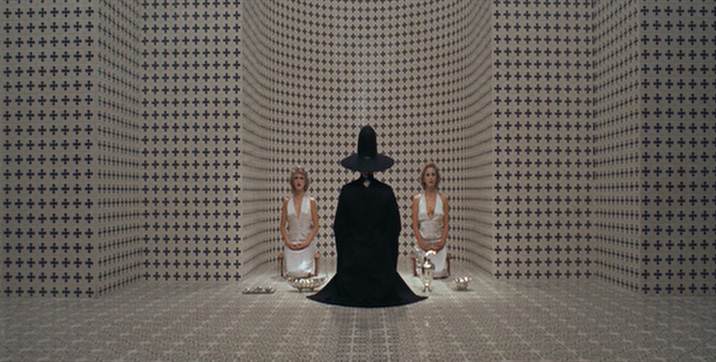
My next endeavor will be to watch the documentary Jodorowsky's Dune. I thought Alejandro Jodorowsky's The Holy Mountain was insane in a very good way, and visually outstanding. The idea that he was also a contender for making Dune is really exciting. Though he wasn't the one who ended up making it, the story behind his concepts must be wild.

Still from The Holy Mountain


Until next time!


Friday, May 8, 2015

Beyond Clueless: Crash Course In The Teen Movie Genre


Beyond Clueless is an excursion through the archetypes of teen films from the 90s through the early aughts, breaking it down into satisfying lumps of teen pudding. Directed by and released in 2014, Beyond Clueless uses the footage from the likes of Ten Things I Hate About You, She's All That, I Know What You Did Last Summer, and ten other Freddie Prince Jr. movies (jk). It features the comedies, horrors, dramas, and romance movies we all know and love, all under the umbrella of teen film. Dividing the experience into five chapters, or stages of development, Beyond Clueless pairs similar scenes and imagery from the selected films in order to express a collective cultural experience.

Jennifer Love Hewitt in Can't Hardly Wait (1998)

It's quite uncanny how formulated these movies appear to be, once set side by side. Of course the existence of a formula shouldn't be too much of a surprise considering the release of 2001's Not Another Teen Movie, which gets the tropes spot on. Beyond Clueless makes the comparisons so fluidly, it's scary. It's not just the themes, it's the mis en scene. It's like watching one image strobe in front of you, only to realize they were slightly different images to begin with. That's exactly the point trying to be conveyed about high school itself.

Rachel True, Fairuza Balk, Neve Campbell, and Robin Tunny in The Craft (1996)

narrates, kicking off the film with her 1996 hit The Craft, explaining succinctly how high school cliques function. The Craft is the perfect starting example of teenage behavior, in the way that it uses the metaphor of a coven and magical powers to represent the strength of teen girl camaraderie and antagonism. Beyond Clueless breaks down the collective teen experience, while analysing how these movies - burned into our brains from youth - mirror our experiences, or convey fantasies of perfection based on desires and expectations.

A strong comparison can be made to 's 2003 found footage film, Bodysong. They both exclusively use unoriginal footage, and break the films up into stages of life. Both have pretty great "sex" scenes. The only difference is Beyond Clueless's narration. Bodysong doesn't feature a single word, as it is scored by Jonny Greenwood of Radiohead. (Side note: you might recognize one of the pieces from Bodysong in the film There Will Be Blood). I digress.
 
What really puts all of these teen films on the same level for analysis and comparison is the sound track. Created by the band Summer Camp, any trace of the pop music from the original films is washed away. No Fatboy Slim to be reminisced over, no Britney Spears - at least not her music. We get a short clip of her in Crossroads, dancing to the sounds of Summer Camp. This removes the implication of time period. While clothing can be a good indicator (and boy is this filled with some late 90s gems), music is much more telling since we can reference the exact date the song was released. Summer Camp's "21st-century alt.pop" style sounds comfortable amongst the 90s and early 2000s film clips. Their sound is more of an homage to 80s pop and 90s alternative, with a certain amount of darkness that heightens the impending doom. Summer Camp is like a cross between The Go! Team and Sleigh Bells. With lyrics that skew toward teen angst, it was a treat to hear lines from The Virgin Suicides in their lyrics (a film which also makes an appearance).

Kirsten Dunst and Josh Hartnett in The Virgin Suicides (1999)

In the opening shots, you might see snippets of movies you loved and cherished. I saw a shot of Laura Palmer from Fire Walk With Me, and got really excited. But there is only one other clip, with Donna Hayward laying down and talking about something dreamy. Some films are only given those seconds, while others are directly referenced and dissected. Beyond Clueless is a psychological, pop-cultural, anthropological dream.

Wednesday, March 4, 2015

The Jinx to Sooth Our True Crime-Loving Souls

In the wake of Serial's season one finale, and the Season Two premiere of True Detective we are so patiently waiting for in summer 2015, a gripping docu-series, The Jinx, is a welcome weekly curiosity.


The opening title sequence even mirrors that of True Detective Season One, with it's double exposures and sexy, silky dark imagery that hints at events to come, and a bluesy song with threatening animistic themes.

True Detective
The Jinx

The credits are a neat package that set the viewer up. It says, "I know what you're looking for and I know what you like."

Robert Durst punctuates his statements with hard blinks made with nearly his entire face. He finishes his statements with a kind of facial enter key.

Robert Durst interviewed by Andrew Jarecki

Durst is allowing his life, experiences, and odd ticks to be scrutinized. At his own request, Andrew Jarecki is interviewing Robert Durst for this six part series. Jarecki directed the 2010 film All Good Things, based on the mysterious disappearance of Robert Durst's wife Kathleen in 1982. This unfortunate event was only the tip of the iceberg for Durst's "bad luck." Jarecki's film doesn't cover all of the deaths surrounding Robert Durst. Of course Durst would want the world to hear his side, even if it uncovers more dirt.

The Jinx unfolds a story starting with Durst's most recent brush with death. In 2001 a body was found in a Galveston, Texas bay. The body was of Morris Black, who was the neighbor of an unfortunate looking mute woman and her brother-in-law (who were never in the same room at the same time). The "duo" had abandoned their apartment when Black's body was discovered, and all signs pointed to that room as the murder scene. Robert Durst, the millionaire real estate heir of New York was pinned as the one who resided in the apartment under a few assumed names. 


After this part of Durst's life is established, the decades move forward and back like waves. The non linear story telling works well here. We are given the information as we need it; dolled out in pieces so we can understand and appreciate each morsel more than the next. We learn about his troubled childhood, the disappearance of his wife, the beginning of their relationship, the night of her disappearance, Durst's inability to connect with Kathleen's family and friends, his abuse towards Kathleen, and then we wind back again to reveal the truth behind what happened that fateful night.

Robert Durst tells half confessions. He has an explanation for everything, for his lies and his motives. Never does he admit to killing Kathleen, but he confesses so much, maybe without knowing it. Robert openly admits to hitting Kathleen, and forcing her to have an abortion. The titular line is uttered here, that Durst thought he would be a "jinx" to his offspring. He labels himself.

Durst shockingly admits to lying to police immediately after Kathleen's disappearance. He added details like a glass of wine he had with a neighbor, or - more importantly - a phone call he claimed he made to Kathleen after she supposedly arrived in New York by train. Durst is flippant about the lies. He explains that it was simply to get the cops to leave him alone. It seemed he didn't understand that lying to the police would make it harder to find Kathleen. Maybe that wasn't his top priority. 

If Robert Durst wants us to believe he didn't kill Kathleen, a story that has sustained 33 years, he doesn't exactly know how to do it. By the virtue of his own psychopathy he lays out his shocking, blatant apathy towards Kathleen. 

Despite the neighbor denying Robert's story about their friendly drink back in '82, among other easily refutable statements, this did not seem to put a wrench in Durst's freedom. Robert's family appeared to work very hard to push this issue under the rug, and he was never convicted of murder. While Kathleen was missing, none even searched the house she was last seen in.

It was also very possible that a phone call supposedly made by Kathleen, the Monday after she was last seen, to her college to call out sick, was actually made by a close female friend of Durst's. Susan Berman was fiercely loyal and knew a thing or two about organized crime and PR. At the time Berman's claim to fame was a novel called Easy Street about her life as the daughter of a mobster. She almost exclusively spoke for Durst to the media during this time. Her story and persona are important to The Jinx, as many people touched by the crimes surrounding Robert Durst are wonderfully fleshed out in each episode.

I don't want to spoil too much....

Robert Durst's persona is a contentious one. Many people have a difficult time getting along with Durst, though he thrives with certain people (like the stepson of Susan Berman. who he may have murdered). Durst did a stint in prison for missing the court hearing for the 2001 murder of Morris Black. Photos of Durst in prison show him palling around with inmates, and I couldn't help but think of his unnerving comfort with all things criminal, and George Bluth Sr.


Many, many people are interviewed in The Jinx, and some may at first seem far removed, but Robert Durst's life infects in far reaching ways that lead a curious trail back to the center. Each new individual brings the promise of a twist or a connection, that makes the series riveting.

Omniscient narration doesn't come into play in The Jinx; the players tell their own stories. Though Kathleen's friends are interviewed singularly, their shared experience in trying to prove Durst's guilt creates a cohesive force; a resounding chorus of voices for Kathleen.

The reenactments in The Jinx are above and beyond the typical poor lookalikes who mime more than they act. It's cinematic, photographic, lush, and somber, creatively utilizing shadow and shallow depth of field to hide the features of the actors. Often shooting from the back of the head (gruesome sounding, I know) they hide distracting faces, and add a cerebral, thoughtful meditation on the individuals they represent.

The triple threat of visual anonymity.

There are only two episodes left to air in this six part series. Much like Serial, we know that the end of the series is most certainly final. Though Serial promises a sort of second season featuring a different topic, or how True Detective will start Season Two with a new cast (and hopefully some thin connection to Season One), The Jinx is truly one of a kind and I cannot foresee a legitimate sequel. But we will be crying for one.

Monday, February 9, 2015

Who Are The Tremonds?


When watching a David Lynch film one often has to let go and accept the strangeness that will unfold. Why was there a creepy elderly woman and young boy popping up from time to time in the Twin Peaks universe? In the series they appear one time. The grandmother and grandson are identified as the Tremonds. They live next door to Harold Smith - a man who Laura Palmer shared dark secrets with. The Tremonds advised Donna Hayward to speak with him, and then mysteriously disappeared as if they were a hallucination.

In Fire Walk With Me, the so called Tremonds are seen again in the Black Lodge.  Now it is certain that these characters are agents or prisoners of BOB, The Man From Another Place, and other beings of the Black Lodge. The pair are other-worldly spirits.


Maybe I originally assumed that the Grandmother and child were a Lynchian archetype from his short film The Grandmother. Both young boys wear suits, which represent adult burdens on children. The suit could also imply death in that a young boy would wear such a formal outfit at a funeral or in a casket.

Still from The Grandmother.

A video I saw by selphiealmasy8 opened my eyes to another possibility in the role of the "Tremonds". They are Leland Palmer's childhood self and his grandmother. 


Leland Palmer explains in Episode 2.10 that he knew BOB as a neighbor at his grandfather's lake house, though he referred him as Mr. Robertson. Leland is one of the few characters who speaks of himself as a child. Benjamin and Jerry Horne discuss their childhood, but their likenesses are seen in a flashback, we never actually see photo or flashback of Leland; all the more likely we can identify Leland as the child. Sometimes it's what isn't said, or isn't shown that reveals the truth.

"He used to shoot matches at me. He'd
say, 'Do you want to play with fire, little boy?'"

The video explains the fact that Leland only mentions his grandfather, and does not mention a grandmother or says, "my grandparent's lake house," which proves that his grandmother was dead at the time.  It also points out that Lynch has a history of conveying a familial relationship through omitting and replacing certain pronouns in FWWM: "My mother's sister's girl." Lynch may be sending a message by not mentioning the grandmother, implying that she is gone, though she had to have existed.

I don't completely agree with the video's explanation that the boy represents a side of Leland that is aware of BOB's possession of him, and the Grandmother represents death to Leland. It doesn't completely explain how they exist. I just can't believe that these two beings inhabit the Black Lodge because Leland is somehow conjuring them up. 

The grandmother was likely a victim of BOB as well. It's quite probable that she lived at the lake house with the grandfather and Leland at one point, and was aware of BOB. Maybe BOB has been collecting members of this family for years. If she is Leland's grandmother, she could have become part of the Black Lodge as a wondering spirit protecting the soul of her grandson. She could have also died a more natural death, and her spirit works to protect Leland's childhood soul in the beyond.  

It is clear that the last names given to the Grandmother and Grandson characters are that of the homes they invade, and not an undisclosed family name of the Palmer's. We learn that the Tremond household Donna visits in Episode 2.2 of Twin Peaks is owned by a Mrs. Tremond. However, she is not the same woman when Donna goes back to show Agent Cooper.

Fake Tremond
Real Tremond

The name of the grandson is left ambiguous. I was pretty sure of this until I read the Twin Peaks Wiki entry that refers to him as Pierre. Then I began to question myself. How do we know that this boy is named Pierre? We don't. He isn't.

He is listed as "Mrs. Tremond's Grandson" on the IMDB page of FWWM and "Little Boy"in the Twin Peaks IMDB. Only the Twin Peaks Wiki calls him as such, and they apparently got it from a set of Twin Peaks trading cards produced by Star Pics.

If he looks like a mini David Lynch that's because he's played by Austin Jack Lynch in the series.

Pierre's card has some pretty bogus facts on it. A commenter named geoffr11 warns in The Black Lodge Encyclopedia, of an article about The Jumping Man, that the Star Pics cards were not cannon to the Twin Peaks universe. It's clear the people who made this card didn't really get what The Little Boy was, and chose to portray him as a real boy who they imagined went to Twin Peaks Elementary and likes magic tricks. It states he was born in 1983, but I think we can all agree he is immortal. And they named him Pierre - out of their butts. So now that we know for sure that the Grandson's name is unknown, his identity as Leland's childhood soul is still viable.

Maybe Little Boy was affectionately named Pierre because in Episode 2.9 he said a phrase in French, which translates to “I am a lonely soul”. Oooh Frenchy knows French, what's this kid's name - Pierre? “I am a lonely soul" is the same message that would later be found written on Harold Smith's suicide note. This shows that the Grandmother and Grandson know facts about the deaths they hover around. It can also imply that they reside in a space (the Black Lodge) that transcends time, so from their perspective everything in the future is clear. The phrase could also be self reflective of the little boy. If he is Leland's sole - the sole that Leland gave up to BOB when he was "just a little boy," - then this character would be a lost soul indeed.

As characters the Grandmother and Grandson are neutral in almost every way. The Twin Peaks Wiki states that Mrs. Tremond/Chalfont "has an unclear link to the Lodges and her intentions are unclear." They have interactions with people, but are not antagonizing. One might argue that if the Grandmother is Laura Palmer's great grandmother, wouldn't she be a bit more loving in her presence, or try harder to keep Laura away from harm? Instead she and her grandson treat Laura as a stranger they have to relay cryptic messages to. I don't have a concrete answer to this, but it could be that since the Grandmother was not alive when Laura was born, she has no emotional attachment to her as a spirit. The little boy wouldn't know Laura as his daughter either, since he embodies only that of Leland's past self. While they seem to be wherever death is, it may be that the Tremonds prepare BOB's victims for the inevitable.


Nothing they do explicitly helps anyone, or harms anyone directly. When Laura sees the couple outside the diner in FWWM, the Grandmother hands Laura a framed picture of a room. The picture later leads Laura through a dream that makes her aware of the green ring and the Black Lodge. The Grandson whispers about BOB/Leland taking Laura's diary:


 "The man behind the mask is looking for the book with the pages torn out. He is going towards the hiding place."

He doesn't use any names, and doesn't imply any urgency. The Grandson just makes the statement, and Laura takes it as she will. Laura is disturbed by this knowledge and it causes her to go home and see that the "man behind the mask" is BOB, and Leland is his mask. The Tremond's information is informative, but Laura still is set on a path towards destruction.

The mask warn by the Grandson in this scene represents Leland's ignorance to his own possession. It also acts as a disguise from Leland himself and Laura. In the Black Lodge Encyclopedia of The Twin peaks Gazette user Sourdust says of the mask, "Significantly then, his true face is never seen by any of the Palmers, who would otherwise be able to identify him."

The Grandson is unmasked in front of Donna, but she wouldn't recognize him as Leland anyway. In the other scenes where he appears outside the Black Lodge in FWWM, the boy is masked in front of Laura, who would recognize him from photos and just generally being familiar with her own father. When Leland is walking away from the motel where Laura is waiting with Teresa and Ronnette for their John (well, Leland actually), he catches a glimpse of the Grandson jumping in the parking lot. Leland may have recognized himself if the mask weren't there.


The only other instance we see the Tremonds interacting with someone in the real world is in Twin Peaks during the scene where Donna Hayward makes her Meals on Wheels delivery. Mrs. Tremond emphatically says that she does not like creamed corn. We learn in FWWM that creamed corn is the physical embodiment of "garmonbozia" which means pain and sorrow. The Man From Another Place and BOB horde garmonbozia, so if anyone says they don't like it, then they must be one of the good guys.


The Grandmother and Grandson's only suspicion comes from being close to death and destruction. In FWWM we don't actually see them at the Fat Trout Trailer Park where Teresa Banks lived. This is the only time they are referred to as the Chalfonts. The land lord of the trailer park tells Agent Cooper that the empty space used to have a trailer in it owned by the Chalfonts, who were an old woman and her grandson.


This explains their other last name. They could have simply possessed the Chalfont residence for a time, as they did with Mrs. Tremond's home. However in this case, the real Chalfonts never return once the Grandma and Grandson disappear. The trailer is gone and the landlord doesn't know where they went. It can only be assumed that this is the same grandmother/grandson pair that we know of, and they split town once Teresa was done for - or after Agent Chester Desmond picks up the green ring under their trailer and inexplicably disappears himself.

Somehow Lynch can always make empty lit rooms seem sinister.

Did they lay the bait, or did BOB?