Friday, May 23, 2014

I Ripped Off the Band-Aid and Watched Dear Zachary

"You still have children." says it all. It is a phrase that beautifully expresses what this film is about without giving too much away. I am glad that I am able to share it with you.


Dear Zachary: A Letter to a Son About His Father is a 2008 film directed and narrated by . I can't say too much without spoiling it, so I will be brief. It's a documentary about a man named Andrew Bagby and the immense wave of life and love that he spread over so many people. Production was between 2001 and 2003, but found footage dates back decades. Kuenne artfully edits in the old footage with the new, making humorous and also heartbreaking mirror imagery.
 
Some notes about Dear Zachary:
 
This film will make you grieve for someone you have never met.
 
It is a living and breathing project that took years to make and evolved in earth-shattering ways. 
 
It will open your eyes to how valuable a life is, and how life and death can be equally enormous.
 
This film will make you hate Canada. I know it sounds weird now - but trust me - you will.
 
It will show you how someone can go through hell and still go on living.
 
If you didn't know already, it will help you understand what it means to love a child.
 
You will cry.

That is all I am willing to divulge. IMDB might say more in the description, but if you haven't already read it or been told by someone else, just go straight from here to Netfilx and watch. 

Friday, April 4, 2014

If You Need a Cure For Being Too Happy...

It has been difficult for me to find content for posts lately. I've had a bit of writer's block, and the documentaries I have watched recently just aren't quite inspiring me in that special way. Or maybe more accurately I've been watching amazing documentaries with subject matter that is hard-hitting, important, and frustrating. I know it sounds like a cop-out to say that I am too fired up about these topics to want to write about them. The opposite should be true. I typically love to delve into the dark recesses of the human soul and promote the brilliant filmmakers who bring us the truth. However, I also didn't want to rain down post after post of doom and gloom and my angry ranting.

Deciding it was best to share what I've seen rather than keep silent, I will present some of the saddest and most frustrating documentaries I've seen as of late. The descriptions are short and sweet. Make of these what you will. If you are in the mood to get up in arms check out these titles.

12th & Delaware (2010)


If you are pro-choice get ready to get rabid. This documentary is about two buildings across the street from each other in a Florida town. Both appear to be abortion clinics. Only one is. Watch as pregnant women enter the impostor building, only to be given ultra sounds and shamed into keeping her unborn baby. Watch the pro-life activist who runs it, tell a pregnant woman who has an abusive boyfriend that keeping the baby may change him for the better.

Hot Coffee (2011)


Everyone has heard the story of the woman who sued McDonald's because she was burnt by their hot coffee. I bet you think she was real dumb and this is an example of a "frivolous lawsuit." What if I told you that the burns she received we so bad that she had to have skin grafts, and it greatly effected her health for the rest of her life and she deserved and needed every penny that she won in that lawsuit? What if I told you that lobbyists for major companies love to make lawsuits like these seem frivolous in order to save a buck; promoting a lack of liability in businesses?

The Devil Came on Horseback (2007)


In 2004 Marine Captain Brian Steidle went to Sudan to document a ceasefire in the Darfur region for the African Union. He witnessed the now famous genocide unfold on a daily basis, coming to the villages in the aftermath with his camera. After almost a year of this he could take no more, went back to the US, and broke his story to the New York Times. To his surprise, despite all of the horrific photographic proof, very little came of it.

 S-21: The Khmer Rouge Killing Machine (2003)


In case you don't know about The Khmer Rouge, you should first read up on it. I did not learn about this in school, maybe because it happened in the 1970s and most "world history" classes only get to WWII by June. This documentary follows one remaining survivor and several men who were teen guards at Tuol Sleng Prison, a Hell that a majority of the population was taken to. All were accused of treason and tortured until they implicated all the other people they knew as well. The torture described specifically plays out some of my worst fears.

Your welcome.

Thursday, March 13, 2014

A Quick Thought About True Detective

I was already feeling a bit disenchanted about how the season finale of True Detective panned out, right about when Rust shoots murderer/spaghetti monster Erroll Childrens in the head. And then this exchange happened.


Marty: “Didn’t you tell me one time, dinner once, maybe, about how you used to ... you used to make up stories about the stars?”
Rust: “Yeah, that was in Alaska, under the night skies.”
Marty: “Yeah, you used to lay there and look up, at the stars?”
Rust: “Yeah, I think you remember how I never watched the TV until I was 17, so there wasn’t much to do up there but walk around, explore, and...”
Marty: “And look up at the stars and make up stories. Like what?”
Rust: “I tell you Marty I been up in that room looking out those windows every night here just thinking, it’s just one story. The oldest.”
Marty: “What’s that?”
Rust: “Light versus dark.”

To put it in Buzzfeed terms,

I was like: 

No.

Not again.

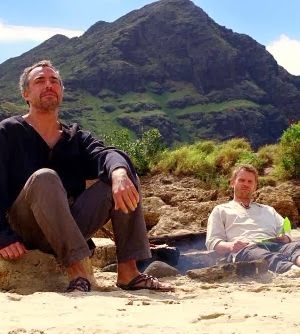
I could not help but think of Lost, and how profound I thought it was; that light vs. dark was a decent enough motif for a show. That - and the mystery behind the Dharma Initiative which surfaced in season 2 - kept me watching through the 6th and final season. (Thankfully I just binge watched the first 5 online and saw the 6th as it aired, instead of wasting 6 years of my life).

Because I liked this:

 And that:

But instead I got this:

 And that:

Too busy crying to notice that everyone sitting in a church answers nothing.

Just like how I liked these things:


 But then I got these things:


True Detective was too good to ride "the oldest story" for the whole season like Lost did. Nothing that sappy is uttered in all 8 episodes until that moment. It felt like that line was used to hurriedly wrap up the show, and make us feel all gushy inside so we forget that very little was actually resolved or explained. If I didn't get confirmation that the next seasons would continue to cover The Yellow King, then I would feel like my dedication to this show was a waste. I'm going to go read The King in Yellow and then I'll get back to you.

Video and transcription from Slate.

Friday, February 28, 2014

My Twin Peaks Infographic: Accomplished!


Follow up to my post from nearly a year ago: this is the completed Twin Peaks Before and After Infographic! I wrestled with the design for a while, but finally came to the final version this past fall. 

To recap - or explain the project to new viewers - this infographic maps the main character actors of David Lynch’s TV series Twin Peaks in their notable roles before and after the series. It's color coded in the hue of Twin Peaks: cherry pie red, black coffee brown, dead lips blue, broken-heart-necklace gold, and of course that cosmic neon green used in the title text. Each colored border around the actors’ photos represent connections between their acting roles.

The order of the cast was decided by free association, with Kyle MacLachlan's Agent Cooper going first and his nemesis Windom Earle (played by Kenneth Walsh) conveniently placing last, along with the other odd morally questionable characters. 

For the background, I attempted to blend the forest with what truly lies within; the black and white chevron floor pattern and red curtains from the Black Lodge.

Each color represents a certain TV show or franchise except for the gold color. The gold border called “Find the Other Half” (in reference to Laura Palmer’s missing broken heart necklace) indicates that an actor shares the screen in a movie or TV series with just one other Twin Peaks cast member. There were 14 pairings which would have made the infographic an ugly confusing rainbow if I stuck with the color code, so I decided to consolidate them while also making it like a game.
The connections may surprise you...

12x36 posters are for sale on zazzle.

CLICK HERE FOR A CLOSER VIEW!


Monday, February 10, 2014

Computer Chess: Through the Eyes of the Machine and All of It's Limitations


Computer Chess takes the period piece to a new level by filming with the period's own media. Director Andrew Bujalski creates a spot-on early 1980s mise en scene, but also adds the perspective of an early 1980s camera. Bujalski (Mutual Appreciation (2005) and Funny Ha Ha (2002)) filmed with analog black and white video cameras (save for a brief scene possibly filmed with color 8mm). The quality of the cinematography is what you would expect from a low budget documentary made in the early 1980s; a simple documentation of a low-profile hotel-hosted event. It's quivering, there's ghosting, it's in 3:4 aspect ratio, and nothing is ever quite in focus. At the start of the film we understand that this is footage from an early 1980s computer programing competition. It is hosted by a pompous, elderly champion chess player who will play the winning computer; the one best programmed to play chess.

The mockumentary status of the film only last for the first few minutes, until we are shown omniscient scenes and angles that could only exists if there were many many nosy, easy to ignore camera men. The camera man who films the actual documentation of the competition is often filmed himself, but by who? That's when it's clear this will be more than a mocukmentary, and the reality of the film is seen through the eyes of the machine and all of it's limitations.

One of the main characters is Wiley Wiggins who is no stranger to mind bending movies thanks to

A film from 2012 called No used a similar technique by filming it's 1988 Chilean period piece with ¾ inch Sony U-matic magnetic tape. This artistic decision is a bold one, since there is a risk that viewers could just not get it and become frustrated with the quality, or on the reverse, be so distracted and enchanted by it's novelty that they would over-look how possibly awful it is on other levels. (I was going to use Casa de Mi Padre as an example, but no one was fooled by that one).

Bujalski uses this film style not only to be super realistic but as a metaphorical tool. Computer Chess is about exactly what it sounds like. The chess board is black and white, so is the film. The video camera is as much a part of technology as the chess playing computers, and by today's standards they are both laughable in their capabilities. Despite the decades of advancement, I can never claim to come close to the level of programing the characters in this film were executing. That said, it is a unique experience to see these characters working hard to find the answers behind a curtain of primitive cinematography, where they are portrayed as complicated and intelligent people and not the butt of a joke about how "simple" computers used to be. The point is that they have never been too simple.

While A.I. sounds like a Steven Spielberg movie from 2001, the characters in Computer Chess discuss the concept of Artificial Intelligence even while they work on computers that can't display video, don't have Internet, and need to be 50 lbs to play a game of chess - and only chess.


Of course the theme that begs to come along with Artificial Intelligence is the differences between computers and humans. Computers are numbers, boxes, logic, metal, wires; they can become stuck in a loop where logic fails. Humans are souls, emotional, social, sexual; they make mistakes but they have the ability to move forward despite this. The foil of the computer chess competition is a couples' retreat held by an African guru. Every day their sessions immediately precede the computer chess competition in the same function hall. The groups are fundamental opposites of each other. The group of computer programmers are in a competition, they are socially awkward and tense. The group of couples on their retreat are always huddled in a circle shouting out strange noises and having re-birthing ceremonies. They seem genuinely interested in the computer people, and want to interact with them despite the lack of reciprocation or outright hostility. The contrast is striking and important. As said by one of these couples, "We don't believe in coincidences."

Computer Chess is not what it seems. I will leave you with some key words and themes to remember: A.I., birth, loops, nature v.s computers, sex vs. nerds, the infinite, cats.


Saturday, January 4, 2014

3 YouTube Channels To Satisfy Your Weird Mind

I love learning strange things. The best assignment I ever had in the 5th grade was to do a project on anything we wanted. I chose the Bermuda Triangle. Later I would go on to write papers on The Donner Party for 8th grade English and the history of prisons in AP US History. The macabre and unexplained have always gotten the most attention from me.

There are many full length documentaries that cover such topics, but what about hours upon hours of short documentaries? These are three YouTube channels that I consider to be educational, though-provoking, and entertaining. These are channels for binge watching, binge learning, and binge having my mind blown.

Vsauce

 Started in 2010 by Michael Stevens, Vsauce is a fast-paced web series that asks and answers life's peculiar questions. Michael manages to tie together biology, physics, psychology, sociology and history; going on a tangent, working from one topic to the next and amazingly coming back to the start. One of my favorite videos called, Why Do We Wear Clothes?, starts with the definition of the word "embarrassed," then to the concepts of being "likable, forgivable and trustworthy," modesty, selective breeding, feelings of disgust, why are babies so inept, and brain size vs. body size. I won't spoil the ending, but I will say that it does come back to answer why we wear clothes -- in a really awesome way.

Michael is enthusiastic about the topics at hand, and it is infectious. He often adds links to his source videos within his own so you can go on another YouTube binge, learning more about the topic you're interested in. Vsauce may not always have a definitive answer, but they always ask questions you never thought of.


Collative Learning


If you like The Shinning or Stanley Kubrick, Rob Ager is the guy to listen to. In his YouTube channel, Collative Learning, Ager meticulously analyses The Shinning as well as 2001: A Space Odyssey, A Clockwork Orange, Eyes Wide Shut, Pulp Fiction, Hellraiser, and The Thing to name a few. There are more such videos under his personal channel. He also made a nine part documentary called Hidden Cinema, discussing subliminal messages in films. I'm a fan of his eight part series on The Shinning's Jack Torrance as an abusive father. He also delves into the confusing layout of the Overlook Hotel, the meaning behind the creepy twins, and something other than blood might be coming out of the elevators.

It beats the hell out of me why Rob Ager wasn't used in Room 237. His theories are just as compelling ( if not more so) as the other Shinning theorists (and he can speak into a microphone). Ager is always reminding us that Kubrick never made any mistakes, so everything has an answer behind it.


Speaking of mistakes...


Cinema Sins

Cinema sins is one of my favorite places to enlighten myself on YouTube because I'm a hater. I love learning about other people's mistakes, especially movie directors, and script girls. Produced by Chris Atkinson and Jeremy Scott, Cinema Sins takes all the questionable parts of a movie (5 to 10 min total) and hangs it out to dry.  They pick out all the inconsistencies, terrible acting, cliches, plot holes, and impossible scenarios. Some may say pointing out the impossible scenarios in a film is a bit picky, because after all, it is just a movie. However, I say dig up all the dirt! I will devour it (even for movies I like). There is an excellent interview by Digital Spy with Atkinson and Scott, discussing what it takes to put these together and how they manage to ever watch a movie for fun without tearing it apart. What I get out of the experience is not only a laugh or a snicker at others shortcomings. It's important to be critical and analytical; not to always be content with everything set down in front of you. Since these videos are meant to be funny-cynical not whiny-cynical, expect to laugh at movies you may have cried at.


I hope you enjoy these channels, and that they change your perspective on the world.

Friday, December 6, 2013

Laura Would Like You To Know...

On closer observation I found similarities between a movie I like very much and a profound documentary I saw recently.


On the left we have Lena Dunham's Tiny Furniture (2010); the pilot to her HBO series Girls as I like to think of it. Dunham plays Aura, a 22 year old college graduate who moves back in with her photographer mother, Siri and over-achieving teen sister, Nadine in NYC. The film features her real life mother, photographer, Laurie Simmons; real life sister, Grace Dunham; and the TriBeCa loft Lena actually grew up in. The title is a nod to the subject matter of Simmons' (and her character Siri's) photography, as well as the overwhelming feeling of being a recent graduate who studied art and does not know where they fit in the world. Boy can I relate to that one [cough cough].. photography BFA.. [cough cough]. Aura is a video performance artist who does not know how to reconcile the life she lived in college with the life she lead(s) with her family. The film could be close to an autobiography for Dunham. She studied creative writing at Oberlin College and graduated in 2008. Certainly Siri is for all intents and purposes Laurie Simmons. I can't speak to whether their personalities match, but they make the same art, and they both have creative daughters.


On the right we have The Woodmans (2010); a documentary directed by that celebrates the life of the late Francesca Woodman and her surviving parents and brother. Francesca was a young promising photographer, who suffered from depression and committed suicide in 1981 at 22 years old. The daughter of the ceramicist Betty Woodman, and painter George Woodman, making art came naturally to Francesca. Her black and white photographs and videos more often than not exposed her nude body, but the backdrop of dilapidated rooms and painful looking props made her nudity about vulnerability, death, and feminism. The documentary features Francesca's journal entries, photography, videos, testimonies from classmates, friends, and family, which reveal her complicated life.


While I completely understand the apparent triviality of comparing Dunham's portrayals of post-college doldrums to a deeply complicated young woman who ended her own life, I could not help but see very real parallels to Dunham's character and Francesca. Let's compare Aura to Francesca. Let's compare a fictional (maybe?) character to a person who lived and breathed.

Left: Video still of Aura's performance art, Right: Francesca Woodman, Untitled: Boulder, Colorado, 1976
Both made performance videos. Both expose their bodies. Lena Dunham famously continues to do this in Girls.

Both had a rough time directly after graduating. Aura's line, "I'm in a post graduate delirium." is a typical Dunhamism about having no direction once you're plucked from the shelter of school life. She announces it as if this is a state of being that she is completely aware of and demands others to understand. Aura is unsure about her ability to be popular on YouTube. Francesca committed suicide a little over 2 years after graduating from RISD, those close to her citing that she was crushed by perceived failures in her art world status. Obviously both felt stuck.

Both lived with their parents in NYC. Francesca moved into her parent's apartment after a suicide attempt shortly before her death.

Both have Jewish mothers and Christian fathers.

Both have artistically successful mothers. As mentioned before, Siri is a famous photographer in Tiny Furniture, and seems to be modeled after Laurie Simmons herself. At the end of Tiny Furniture, Aura asks Siri, "will I ever be as successful as you?" heavily hinting that Aura idolizes her mother and is concerned about her own future and her future alongside her mother as a fellow artist. Similarly Betty Woodman is and was a successful ceramicist. During The Woodmans it is implied that Francesca was preoccupied with notoriety and success, and had standards that were calibrated by her parent's own successes.

Left: Laurie Simmons photographing tiny furniture, Right: Betty Woodman, ceramicist

Both young women experienced the distance artists create around themselves. They know the barriers their mothers put up. Aura makes multiple attempts to sleep in Siri's bed, but without Siri present - sometimes even with her present- this is a strictly prohibited act. Aura says, "I'm really mature. But every time I come into your room, I wanna sleep in your bed." This establishes her neediness. And stating that you are mature is not very convincing.

Francesca lived in an environment where she was expected to be fiercely independent at an early age, and was often left alone in foreign museums on family vacations. Though Francesca was independent of her parents, she was known to have intense needy relationships with men and her female friends.

Both know the barriers they put up themselves. There is a scene in Tiny Furniture when Aura's old pre-college life becomes her new life again, and her college life is down-graded to old life status. Aura's performance video is in an exhibition thanks to her childhood friend Charlotte (Jemima Kirke). They have been carrying on since Arua moved home, which has made returning the phone calls of her best friend from college, Frankie, impossible. In a last ditch attempt to get through to Aura, Frankie arrives at the art opening only to find that her presence is no match for Charlotte and a sous chef who can't be bothered.

Other weird parallel: Jemima Kirke (pictured right) is a painter and went to RISD just like Francesca
While watching Aura snub Frankie over wild and artistic Charlotte, I couldn't help but hear Francesca Woodman's childhood friend Patricia. Patricia stated in the documentary that in their teen years Francesca was less interested in continuing their friendship. She described it well by saying she was not "useful" to Francesca at the time.

At several moments in Tiny Furniture Aura reads from Siri's diary, circa her 20's, and it is reminiscent of passages from Francesca's diary which are read during the documentary. They both mention insecurities about womanhood and needing to make art; feeling impotent and unsure. Those moments make Tiny Furniture seem like a movie about Francesca's life if she lived into her 50s and had children. Obviously Francesca and Laurie Simmons, aka Siri, have astronomically different photographic techniques (black & white organic and messy imagery of nudes in eerie or unsafe looking environments vs. vivid color photos of doll house furniture, paper dolls; everything dolls and domesticity), but both tackle feminism and female roles in their work.

In this general way a comparison can be made between these women; their age, sex, artistic medium. However, it shows that a story like Francesca Woodman's is a painfully relatable story for female artists across generations. The stories Lena Dunham writes are painfully relatable as well. We see from Tiny Furniture that Aura and her mother are not too dissimilar, and maybe Siri is a beacon of hope, that all people have awkward stages but they can find their place. When Aura asks, "will I ever be as successful as you?" Siri flippantly responds "Oh that won't be hard."

Thursday, October 31, 2013

Halloween 2013: Now Everyone Can Learn Something!

I did it again. My Halloween costume was bizarre, hard to explain, and related to something I discovered while writing this blog. Back in July I wrote about an excellent documentary called Resurrect Dead which investigates the existence of messages embedded in the pavement known as Toynbee Tiles.

Me as a Toynbee Tile

Your standard Toynbee Tile

The short version of the story is that someone or some people have been placing these linoleum tiles in roads across the country since the 1980s. The message is always "Toynbee Idea/In Kubrick's 2001/Resurrect Dead/On Planet Jupiter" which roughly means that historian Arnold Toynbee's theory - that you can resurrect everything that ever lived by gathering up all the particles - can be achieved on Jupiter, and Stanley Kubrick's film 2001:A Space Odyssey proves this. It's a really strange concept, and even stranger why the messages must be placed in roads.

Promo photo for the documentary Resurrect Dead

In September I saw a Toynbee Tile IRL in St. Louis. That's about as far west as you can find them. I nearly stopped traffic as I walked past it in the cross walk. It was an honor.

The Toynbee Tile I found in St. Louis on 8th and Main St. 9/13
Come October, I had a great idea for a cheap (yet confounding) Halloween costume. All it took was a black shirt and multicolored masking tape. And if it comes out wonky: no worries! Toynbee Tiles are typically mishapped anyway. Stick on some desperate paranoid statements if you have room. I managed to add an ominous "You Must" on my shoulder. Also, put some renegade smooshed tile (masking tape) on your face to complete the look. Note: make sure your face is completely clean, because it is hard to make masking tape stick to skin, let alone slightly oily skin. There was more tape on my eyebrows, but this photo was taken at the end of a fun night.


Keep it strange. Happy Halloween!

Saturday, October 26, 2013

I Knew You Didn't Feel Like Sleeping: Happy Halloween!


There is something macabre about most of my posts, whether it's a documentary about odd people, strange phenomena, campy and nostalgic TV shows, the horrors of mother nature, history, or a catastrophe. In the spirit of Halloween I compiled the spookiest of my posts. I've dished out a bit of true crime, a bit of horror film dissection, and a touch of the supernatural. Queue up your Netflix. This list will keep you occupied (and looking over your shoulder) through All Hallows Eve. 

Room 237

This documentary attempts to lay bare the hidden messages Stanley Kubrick left in his classic horror film The Shining. I recommend watching Room 237 and then take a crack at The Shining after. See if you can spot them all, or start your own Kubrick conspiracy theory!


VBS Meets... Issei Sagawa

An interview with a real cannibal who committed a heinous crime and is free and living in Japan... Be prepared for gruesome crime photos.

Hunting for a Quality Ghost Show

This is the most viewed post on Consume+Consume. This is probably true because a lot of people are hunting for a quality ghost show by typing this very headline into Google. If you do reach this article in that manner, will your prayers be answered? Click to find out.

Nightmares in Red White and Blue

History as told by horror films. See how since the inception of motion pictures art has been imitating life on a deep psychological level.

Cropsey and H.H. Holmes: America's First Serial Killer

Two stunning tales of serial killers from different eras, I paired these two documentaries in a post deemed a "double feature." Cropsey not only discusses the nightmarish string of murders of defenseless mentally challenged children, but also the horrors of the mental health system in the 1970s. H.H. Holmes:America's First Serial Killer tells the tale of a well respected doctor who committed murder to a scale never before  seen in the late 1800s. Whether you can stomach both at once is entirely up to you.

Sweet dreams!