Thursday, August 21, 2014

Deleted Scenes from Fire Walk With Me That Should Not Have Been Deleted

I got Twin Peaks: The Entire Mystery with Fire Walk With Me and all the deleted scenes, remastered and on Blu-ray!
Now this is what I loved about them:

SPOILERS!

1. Buenos Aires / Above the Convenience Store

The David Bowie scene in the original cut of Fire Walk With Me was brief. Brief enough to be bizarre and in line with David Lynch's penchant for randomness and leaving us with more questions than answers. The scene starts with a man getting off an elevator in the Philadelphia FBI headquarters where Agent Cooper works. That man is David Bowie, and you think, "Cool, what the heck is he doing here? Boy David Lynch is sure taking me on a wild ride." Bowie is dressed in a tropical shirt and baggy khaki suit; a stark contrast to the standard FBI black suit and tie attire. Everyone else in the room - David Lynch as Chief Gordon Cole, Kyle MacLachlan as Agent Dale Cooper, and Miguel Ferrer as Agent Albert Rosenfeld - knows who this is. It's Phillip Jeffries, the long lost FBI agent.

Jeffries stands there and starts talking like a person with dementia, talking about a "Judy" that we don't know is psycho babble or actually relevant to these men. Just before you think David Bowie is going to say something of worth the scene fuzzes out like a crossed transmission and all of a sudden we're in a world that is reminiscent of the types of dreams Cooper would have on Twin Peaks.

I couldn't sleep so now no one can sleep.

This dream does have the Man From Another Place (the dwarf) and Bob in it, but it also includes two lumber jack guys, an old black man, the old woman and her creepy magician/ mini David Lynch grandson (aka the Tremonds), and a terrifying man with a white mask, red suit, and high top hair cut.


As expected the "dream" does not directly answer anything with it's coded language, but maybe with a few more watches... You hear bits of what Jeffries is telling the detectives, if you can tell that's what's going on at all; it's very much inter-cut with the things the dwarf and others say. Then we get a shot of Jeffries in the office talking but without synced sound, and finally a TV fuzz shot of him screaming in apparent agony. When the time is right the dream fuzzes out and we're back in the office. Gordon Cole is yelling that Jeffries has disappeared into thin air. We missed him disappearing, and we never get to see Jeffries again or know really what he said to Cooper, Cole, and Rosenfeld.


In the deleted scene you get Jeffries talking and the dream separately. It's an extra 5 minutes that should have been kept in. It would not have given too much away, or been too wordy. Jeffries actually sits down and starts talking as though he just made a harrowing journey and is trying to recount it so everyone can understand. Jeffries explains that he lived above a convenience store with a group of people. This is HUGE, because we all know from Twin Peaks that Bob and Mike lived above a convenience store (and now we know that this was important because it turned out to be the Black Lodge). Jeffries explains the situation and the dream becomes more of a twisted perspective on the infamous apartment above the convenience store / Black Lodge, and less of a random idea Lynch had to freak us out. After Jeffries sufficiently disturbs everyone with his story Cole tries to get the receptionist to answer on the intercom while the lights flicker. Jeffries notices the date and seems confused. Cole turns his head to look back at Jeffries and he's gone.

Then Jeffries appears with light and flame in the hallway of a Buenos Aires hotel, leaving a scorch mark on the wall. He scares the shit out of those who witness this and, to put it mildly, he looks pretty ragged from the journey. The screaming moment from the original cut of FWWM is from this deleted scene. I felt like this last bit was not really necessary. It opens up a whole plot device about time travel that no one else in the Twin Peaks series or FWWM experience. If there is evidence that this does occur with other characters then it is much more subtle and open to interpretation. There's another scene preceding this of Jeffries checking into the hotel, which gives the time and space jump context. I was just happy to hear Jeffries' story, I don't care where he went when he disappeared. It could have been somewhere interesting and relevant like the Black Lodge but since it was just Argentina, who cares? I guess that's why these were cut, but it doesn't explain why the speech was cut at all.
Here is some of the speech.


Jeffries stumbles to a chair.
JEFFRIES:
Listen to me carefully. I saw one of their meetings. It was above a convenience store.
ALBERT:
Whose meeting? Where have you been?
COLE:
FOR GOD SAKES, JEFFRIES, YOU’VE BEEN GONE DAMN NEAR TWO YEARS.
JEFFRIES:
It was a dream.
(takes Albert by the arm)
We live inside a dream.
ALBERT:
And it’s raining Post Toasties.
JEFFRIES (shouting):
NO. NO. I found something … in Seattle at Judy’s … And then, there they were …
Albert is about to say something, but is stopped by Cole’s gentle pressure on his arm.
JEFFRIES:
They sat quietly for hours.
"They sat quietly for hours." [shudders]

Another addition to the Black Lodge dream in this extended scene is a super imposition of Laura staring off with an unblinking almost dead expression while double images of the group in the apartment hover over. If that was kept in this would be our first image of Laura in FWWM, implying that she was dreaming the same thing Jeffries saw. It gives more insight to her reaction to the Tremonds in the parking lot of the RR Diner where they give her the framed photograph.
 

2. Party Girl


In this deleted scene we see a flashback Leland Palmer calling Theresa Banks to make a date for a four-way. It is about one year before Laura's murder. He's called on Theresa's services before and creepily compared her to his daughter Laura. Little does he know Laura as well as Ronette Pulaski are Theresa's other friends, ready for anything. In FWWM Leland has this flashback after he and Laura are accosted by Mike the one-armed man. He sees Laura through a window in the motel room as she and Ronette pass the time waiting for their John. Leland says "I chickened out." gives Theresa the cash and runs away. Theresa knows something is fishy here.

In the deleted scene Theresa explains to Laura and Ronette that the John chickened out. They spend a moment lounging on the bed together with some palpable sexual tension. Theresa slowly brushes her hair off her face as she looks seductively at Laura. Laura notices the ring on Theresa's hand. It's the same blue green ring with the owl symbol she would later see in a dream, and then also thrust in her face when Mike the one-armed man starts screaming at her and Leland in the street. 


After a freeze frame on Laura looking back at Theresa and the ring, we cut to Theresa calling Jacque Renault to pry information about Laura and Ronette's fathers. She concludes that the John must have been Laura's father, and immediately calls him up. After she says hello we cut to Leland in his office silently listening to her blackmail him. Then we know that this was his motivation to murder Theresa Banks.

The blackmailing is only implied in the original cut of FWWM. During the scene where Laura and Ronette talk to Jacque in the very loud, red Canadian bar, we can read in Jacque's subtitles that Theresa was interested in Laura's father's appearance. Laura gets very agitated upon hearing this.

We also see in FWWM that Laura reflects in her bedroom about the ring she saw in Mike's hand. She has a flashback to quick cuts of the deleted scene, specifically the gif image above, reminding her where she saw it.

I can understand that the flashback sequence would have seemed redundant if they kept the whole scene with the three of them in the motel room. I suppose Laura could have had her own complete flashback of this moment from her perspective, as Leland did of his perspective, but I also can't resolve where that could have been placed in the film. Although it might have completed the connection of why Laura even had a memory of Theresa looking at her from that angle etc. Overall it's a beautifully shot scene that I'm glad was recovered.

 3. Bob Speaks Through Laura / Blue Sweater

This cut scene depicts a moment when Laura is encountered by the spirit of Bob in the stairwell to her bedroom. It appears that he speaks to her through the ceiling fan. As he says sexually predatory things to her she harshly whispers to herself trying to fight him out of her mind. The fan seems to mesmerize Laura and we see a helpless staring face slowly shape into a menacing grin.

This is not at the menacing grin stage yet btw.
We are seeing Laura pulled to the dark side. For most of the movie Laura is either bad or good. We see her doing normal high school things with Donna, even if they get a bit emotional. Or we see her hooking and snorting coke like a champ. I think we're expected to think that as soon as she walks out the door of her house it's either going to be one or the other. Inside the Palmer home is complete uncertainty of safety and sanity. Laura and her parents have incredibly tense moments that border on abusive.

Who wants breakfast!
If you thought breakfast was a hoot, try dinner!
Seeing her give in to Bob in the moment is important to illustrate how Laura moved between both worlds.

Side note: it reminds me of the scene in FWWM where Bob comes through Laura's window and for the first time in this film - and in Twin Peaks history - the sight of Bob doesn't render the viewer a screaming flailing mess.

She allows him to get on top of her, and she is maybe even turned on for a minute. She asks "Who are you?" and in that moment we see Leland's face, and that's when Laura starts screaming in horror. (Which is horrifying because it's incest, so I guess if you had to choose which is more horrifying...)
Anyway...
Laura's trance in the stairwell is interrupted by her mother, Sarah Palmer, asking where her blue sweater is. Laura says to her, "You're wearing it." Sarah realizes her error and begins to panic. She cries and says, "It's happening again." Sound familiar? It's the same line the Giant says over and over again to Cooper in Twin Peaks when Laura's cousin Maddie is being murdered by Leland.

The blue sweater must be symbolism for something being right under your nose (like the sexual abuse of Laura at the hands of her father). It's happening again and again and you didn't even know. Sarah appears to be upset because she didn't notice she was wearing the sweater, maybe on the surface referencing an unmentioned mental issue that's flaring up. Laura tries to calm Sarah insisting that it's not happening again and it's OK.

I really appreciate the reference back to Twin Peaks in this scene and I think the whole bit with Laura being entranced into Bob's world and the sweater would have benefited FWWM. 

Honorable Mentions

Distant Screams
 This was a very short deleted scene that just shows the Log Lady crying in the dark with her log while you can faintly hear the screams of Laura and Ronette in the distance, or maybe in her mind as the log telepathically gives her the message. In Twin Peaks the Log Lady says "My log heard something that night." This is presumably depicting that moment. In FWWM the Log Lady confronts Laura and tells her about how easily innocence can be burned up by evil. If the deleted scene were kept in it would have still made perfect sense and would take the Log Lady's influence full circle.

Asparagus 
This one is pretty much a throw away scene, but it references Laura not liking asparagus, which is important - sort of. While reading her diary in Twin Peaks, Agent Cooper reads an entry from the night of Laura's murder where she writes, "Asparagus for dinner again. I hate asparagus. Does this mean I'll never grow up?"

I just admire the attention to detail; that they filmed this as a nod to the TV series, putting effort into staying consistent and attempting to put the whole puzzle together.

I highly recommend this box set. If you don't have a Blu-ray player find a friend that does and make them watch it with you. Enjoy all the extra content and the other fun that comes inside the package...


Thursday, June 26, 2014

I Don't Always Lead A Cult, But When I Do...


The perfect embodiment of a hippie 70s spiritual, white robed, naked, yogi, Utopian, vegan cult is The Source Family. We have seen so many parodies of this style of cult in pop culture, on the first watch of their documentary The Source Family, it seems like a joke. While The Source Family weren't the first hippie cult, they were surely a huge cultural influence considering they originated in Hollywood, CA and made their living serving vegan foods to the rich and famous on the Sunset Strip.


The leader/father/god was James Baker, who's life reads like a Dos Equis commercial, or a Bill Bradsky skit (got to love Will Ferrell SNL circa 1999). He's a war hero, jujitsu champion, murderer, millionaire, restaurant tycoon, and self proclaimed god.

The Source Family (2012) by and , is an amazingly thorough documentary due in part to the member, Isis Aquarian. She is the family historian for the Source Family, and always had a camera or a tape recorder in her hand. This cult wanted everything documented. You've got weddings, home births, meditations, musical performances, outings, shifts at the Source Restaurant... even death...


But on the topic of birth, something I've noticed about these types of cults is that the women members are always pumping out kids like nobody's business. It comes from an Adam and Eve complex where women, as individuals who can make more people appear out of their vaginas, are expected to help increase the population of believers. These children are only going to know the reality that you make for them in the first few years, so that will totally prime them for becoming built-in loyal followers.

No matter how "progressive" a cult of this nature appears to be, the birthing and the isolation appears completely anti-feminist. It's the idea that:

1. It's convenient that the female members are ladies, so they can give birth. So why don't you already?

and

2. Since we're so into ancient religions and practices, dressing like druids, and going back to nature, shouldn't we just throw away decades of advances in a woman's right over her body? Did ancient women take the pill? I didn't think so. So why don't we just do it and let's not worry about who's kid it is or who's going to take care of it, because we'll all "take care" of it. You've got so many hang ups man. I mean worrying about controlling the ability to not be pregnant is just a jail you put yourself in.  Think about it.


It is still an odd concept to grasp that these children were born into this; that they didn't have a choice and, at least till the cult disbanded, knew this as their way of life. There are so many horror stories about the children of cults, however many of those come from the more subversive ones . The Source Family never had any real serious issues with child welfare in comparison to, let's say, Jonestown. It looked like everyone in the Source Family had a healthy relationship with the nude form, which you can twist into sexual perversion if you want to, but it was the 70s and hippie parents outside of cults were trying to establish a healthy body image that was removed from shame and dirty fifthly sex too.

The one thing that happened in the Source Family that would be considered the endangerment of a child, is the lack of conventional medicine. Of course. One member left the group because his young son was very sick with an infection and they strongly disagreed with him going to a hospital or being treated with antibiotics. Of course.

Oh - and then there was the statutory rape. The Source Family attracted under aged women, and the first birth in the Source Family mansion was from a 16 year-old girl. Which you get to watch in the documentary! 

There's footage of the Source Family band, YaHoWha 13, recruiting - err a - performing at a high school. While James Baker paced around the stage talking about how great his cult is, I knew that Will Ferrell should play him in a movie. Or even just a Funny or Die short. As it happened I could picture him with long grey hair and beard doing a combination of Terrence Maddox the inappropriate nude model and Prof. Roger Clarvin the sexually open professor inclined to call his wife "la-vah."

Will Ferrell era SNL FTW!

During that whole scene I couldn't understand how they were allowed to perform at high schools. Can you even imagine being told that there was a special treat for everyone at 1:30, and that was a cult playing improvisational psychedelic music? And it was a cult? The Source was well known in California. Actually at that time in the 1970s the idea of a group of young people lead by a creepy guy who was pursuing a music career should have reeked of Manson. And I don't believe attendance was completely voluntarily. If you look at the number of kids there, and the looks on their faces, the principle probably ordered them into the court yard, made them sit Indian style, and said you're gonna listen to these damn hippies and their music and you're going to like it!

This involves a kind of lack of insecurity that can never reach high school kids.

Aside from making a bunch of hippies say "what was I thinking" or creating more kids that have embarrassing stories about open nudity in their households, The Source Family as a cult was pretty harmless. People who chose to leave weren't hounded or threatened, or even damned to hellfire. No one was murdered, just hearts broken, because sharing a man/god with 12 other women sucks.


Monday, June 23, 2014

A Fire You Can't Put Out

"This process is necessary to prevent such a terrible thing to ever happen again."

- Philadelphia Special Investigation Commission Chairman William H. Brown III, 1985

Being nostalgic for the 90s is what people do now, and I'm no exception. I was 6 in 1993, so I was somewhat aware of the news but definitely not all the shady details. The ESPN 30 for 30 documentary by Brett Morgan called June 17th, 1994 is amazing to watch if you know about the white Bronco chase with OJ Simpson, but didn't know it was one of the biggest days in sports history. Seriously - so many things were happening that day and history was being made, but OJ really cluttered up the news. It's a superb documentary, and the kind where the director lets the found footage do all the talking - which is my favorite style of documentary - but this isn't about June 17th, 1994. 

That doc about the 90s spurred me on to watch a doc about another event that happened in my lifetime, but was too young to understand. I started searching for Waco.

Director: Wiliam Gazecki 1997
On YouTube I found Waco: The Rules of Engagement. Directed by , the film mostly conveys an anti ATF stance, where footage and phone conversations between the cult group, the Branch Davidians, and the FBI show that the US government ruthlessly attacked women and children in the name of suppressing a group that was stockpiling weapons. During the 51 day siege, there were disputes over who fired the first shot, the ATF insisting one of the Davidians fired first, prompting the incessant teargassing and machine gun fire that would eventually set the compound ablaze and kill 76 people.

While the leader David Koresh was infamous for allegations that he was sexually abusing young female followers, certain scenes from the subsequent trial, implied that discussion about the sexual perversions of David Koresh were considered a diversion from the serious transgressions of the ATF. For instance, the ATF's defense brought in a witness who was molested by Koresh years before when her family was in the cult. While her testimony was tragic the prosecution questioned the relevance and reminded the defense that despite what David Koresh may have done to those poor people, the ATF was still under fire for possibly contributing to the effective execution of those individuals who were victimized by Koresh as they described. This thorough film makes a point to stay on track and focus solely on the siege and it's aftermath.


 With this still fresh in my mind, I searched Netflix for similar fare, and the title Let The Fire Burn caught my eye.

Director: Jason Osder 2013
As it turns out, eight years earlier, another group considered to be a cult, was burned alive in their compound. This time, it took place in West Philadelphia. It's 1985, Mother's Day, and the Pennsylvania State Police are once again after the black liberation / back to nature cult, the Move Organization. Move was thought to have stockpiled fire arms, in addition to creating dozens of complaints from neighbors concerning building codes and aggressive behavior. They, like the Davidians, experienced a siege. Theirs only lasted 24 hours, but managed to destroy 60 homes in a dense neighborhood. Only two people in the Move house survived.

Much like Waco, the facilitators of the siege were taken to court over the validity of the force and fire used to vacate the people of Move from their house; a force that appeared to be an outright murder rather than an evacuation.

It is disheartening to know that something like this would happen over again, and I wonder what other instances of this escalation have happened or could be currently happening.

This is a venn diagram of how the Waco siege and the Move siege held many similarities.
The opening quote spoken by William H. Brown III is from court room footage in Let The Fire Burn. The "process" he describes is the thorough interviews and testimonies given by the police, the remaining and former members of the cult organization in question, and the innocent civilians who were affected. All sides believed themselves the victims in some aspect, and it was important to hear all sides to find justice.

The similarities of this incident to Waco struck me, but I believe the Move siege appeared to have affected many more people who had nothing to do with Move or the Philadelphia police. On the one hand the neighbors did want to see Move, well, move. On the other hand the police wanted to smoke out 11 people from one building so badly 60 homes were destroyed in the process. While the citizens had negative testimonies concerning Move's relationship to the community, they were rightfully up in arms over how the Philadelphia police handled the situation.

Between the two documentaries Let The Fire Burn was my favorite. Waco: The Rules of Engagement
was informative, but very long, clocking in at over 2 hours. As mentioned earlier, I really enjoy a documentary that can convey it's message without talking heads or narration in the traditional sense, and Let The Fire Burn was successfully made in that style. Footage from local news stations of that fateful day are interwoven with segments of a student documentary from the 1970s about Move, and video of the court proceedings with some captions, but no narration whatsoever. It gives you a sense of the time period and the emotions flowing behind every viewpoint. It speaks to all sides of the story and attempts at purveying the truth.

Friday, May 23, 2014

I Ripped Off the Band-Aid and Watched Dear Zachary

"You still have children." says it all. It is a phrase that beautifully expresses what this film is about without giving too much away. I am glad that I am able to share it with you.


Dear Zachary: A Letter to a Son About His Father is a 2008 film directed and narrated by . I can't say too much without spoiling it, so I will be brief. It's a documentary about a man named Andrew Bagby and the immense wave of life and love that he spread over so many people. Production was between 2001 and 2003, but found footage dates back decades. Kuenne artfully edits in the old footage with the new, making humorous and also heartbreaking mirror imagery.
 
Some notes about Dear Zachary:
 
This film will make you grieve for someone you have never met.
 
It is a living and breathing project that took years to make and evolved in earth-shattering ways. 
 
It will open your eyes to how valuable a life is, and how life and death can be equally enormous.
 
This film will make you hate Canada. I know it sounds weird now - but trust me - you will.
 
It will show you how someone can go through hell and still go on living.
 
If you didn't know already, it will help you understand what it means to love a child.
 
You will cry.

That is all I am willing to divulge. IMDB might say more in the description, but if you haven't already read it or been told by someone else, just go straight from here to Netfilx and watch. 

Friday, April 4, 2014

If You Need a Cure For Being Too Happy...

It has been difficult for me to find content for posts lately. I've had a bit of writer's block, and the documentaries I have watched recently just aren't quite inspiring me in that special way. Or maybe more accurately I've been watching amazing documentaries with subject matter that is hard-hitting, important, and frustrating. I know it sounds like a cop-out to say that I am too fired up about these topics to want to write about them. The opposite should be true. I typically love to delve into the dark recesses of the human soul and promote the brilliant filmmakers who bring us the truth. However, I also didn't want to rain down post after post of doom and gloom and my angry ranting.

Deciding it was best to share what I've seen rather than keep silent, I will present some of the saddest and most frustrating documentaries I've seen as of late. The descriptions are short and sweet. Make of these what you will. If you are in the mood to get up in arms check out these titles.

12th & Delaware (2010)


If you are pro-choice get ready to get rabid. This documentary is about two buildings across the street from each other in a Florida town. Both appear to be abortion clinics. Only one is. Watch as pregnant women enter the impostor building, only to be given ultra sounds and shamed into keeping her unborn baby. Watch the pro-life activist who runs it, tell a pregnant woman who has an abusive boyfriend that keeping the baby may change him for the better.

Hot Coffee (2011)


Everyone has heard the story of the woman who sued McDonald's because she was burnt by their hot coffee. I bet you think she was real dumb and this is an example of a "frivolous lawsuit." What if I told you that the burns she received we so bad that she had to have skin grafts, and it greatly effected her health for the rest of her life and she deserved and needed every penny that she won in that lawsuit? What if I told you that lobbyists for major companies love to make lawsuits like these seem frivolous in order to save a buck; promoting a lack of liability in businesses?

The Devil Came on Horseback (2007)


In 2004 Marine Captain Brian Steidle went to Sudan to document a ceasefire in the Darfur region for the African Union. He witnessed the now famous genocide unfold on a daily basis, coming to the villages in the aftermath with his camera. After almost a year of this he could take no more, went back to the US, and broke his story to the New York Times. To his surprise, despite all of the horrific photographic proof, very little came of it.

 S-21: The Khmer Rouge Killing Machine (2003)


In case you don't know about The Khmer Rouge, you should first read up on it. I did not learn about this in school, maybe because it happened in the 1970s and most "world history" classes only get to WWII by June. This documentary follows one remaining survivor and several men who were teen guards at Tuol Sleng Prison, a Hell that a majority of the population was taken to. All were accused of treason and tortured until they implicated all the other people they knew as well. The torture described specifically plays out some of my worst fears.

Your welcome.

Thursday, March 13, 2014

A Quick Thought About True Detective

I was already feeling a bit disenchanted about how the season finale of True Detective panned out, right about when Rust shoots murderer/spaghetti monster Erroll Childrens in the head. And then this exchange happened.


Marty: “Didn’t you tell me one time, dinner once, maybe, about how you used to ... you used to make up stories about the stars?”
Rust: “Yeah, that was in Alaska, under the night skies.”
Marty: “Yeah, you used to lay there and look up, at the stars?”
Rust: “Yeah, I think you remember how I never watched the TV until I was 17, so there wasn’t much to do up there but walk around, explore, and...”
Marty: “And look up at the stars and make up stories. Like what?”
Rust: “I tell you Marty I been up in that room looking out those windows every night here just thinking, it’s just one story. The oldest.”
Marty: “What’s that?”
Rust: “Light versus dark.”

To put it in Buzzfeed terms,

I was like: 

No.

Not again.

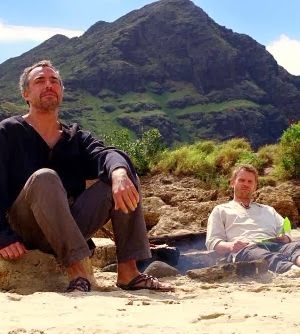
I could not help but think of Lost, and how profound I thought it was; that light vs. dark was a decent enough motif for a show. That - and the mystery behind the Dharma Initiative which surfaced in season 2 - kept me watching through the 6th and final season. (Thankfully I just binge watched the first 5 online and saw the 6th as it aired, instead of wasting 6 years of my life).

Because I liked this:

 And that:

But instead I got this:

 And that:

Too busy crying to notice that everyone sitting in a church answers nothing.

Just like how I liked these things:


 But then I got these things:


True Detective was too good to ride "the oldest story" for the whole season like Lost did. Nothing that sappy is uttered in all 8 episodes until that moment. It felt like that line was used to hurriedly wrap up the show, and make us feel all gushy inside so we forget that very little was actually resolved or explained. If I didn't get confirmation that the next seasons would continue to cover The Yellow King, then I would feel like my dedication to this show was a waste. I'm going to go read The King in Yellow and then I'll get back to you.

Video and transcription from Slate.

Friday, February 28, 2014

My Twin Peaks Infographic: Accomplished!


Follow up to my post from nearly a year ago: this is the completed Twin Peaks Before and After Infographic! I wrestled with the design for a while, but finally came to the final version this past fall. 

To recap - or explain the project to new viewers - this infographic maps the main character actors of David Lynch’s TV series Twin Peaks in their notable roles before and after the series. It's color coded in the hue of Twin Peaks: cherry pie red, black coffee brown, dead lips blue, broken-heart-necklace gold, and of course that cosmic neon green used in the title text. Each colored border around the actors’ photos represent connections between their acting roles.

The order of the cast was decided by free association, with Kyle MacLachlan's Agent Cooper going first and his nemesis Windom Earle (played by Kenneth Walsh) conveniently placing last, along with the other odd morally questionable characters. 

For the background, I attempted to blend the forest with what truly lies within; the black and white chevron floor pattern and red curtains from the Black Lodge.

Each color represents a certain TV show or franchise except for the gold color. The gold border called “Find the Other Half” (in reference to Laura Palmer’s missing broken heart necklace) indicates that an actor shares the screen in a movie or TV series with just one other Twin Peaks cast member. There were 14 pairings which would have made the infographic an ugly confusing rainbow if I stuck with the color code, so I decided to consolidate them while also making it like a game.
The connections may surprise you...

12x36 posters are for sale on zazzle.

CLICK HERE FOR A CLOSER VIEW!


Monday, February 10, 2014

Computer Chess: Through the Eyes of the Machine and All of It's Limitations


Computer Chess takes the period piece to a new level by filming with the period's own media. Director Andrew Bujalski creates a spot-on early 1980s mise en scene, but also adds the perspective of an early 1980s camera. Bujalski (Mutual Appreciation (2005) and Funny Ha Ha (2002)) filmed with analog black and white video cameras (save for a brief scene possibly filmed with color 8mm). The quality of the cinematography is what you would expect from a low budget documentary made in the early 1980s; a simple documentation of a low-profile hotel-hosted event. It's quivering, there's ghosting, it's in 3:4 aspect ratio, and nothing is ever quite in focus. At the start of the film we understand that this is footage from an early 1980s computer programing competition. It is hosted by a pompous, elderly champion chess player who will play the winning computer; the one best programmed to play chess.

The mockumentary status of the film only last for the first few minutes, until we are shown omniscient scenes and angles that could only exists if there were many many nosy, easy to ignore camera men. The camera man who films the actual documentation of the competition is often filmed himself, but by who? That's when it's clear this will be more than a mocukmentary, and the reality of the film is seen through the eyes of the machine and all of it's limitations.

One of the main characters is Wiley Wiggins who is no stranger to mind bending movies thanks to

A film from 2012 called No used a similar technique by filming it's 1988 Chilean period piece with ¾ inch Sony U-matic magnetic tape. This artistic decision is a bold one, since there is a risk that viewers could just not get it and become frustrated with the quality, or on the reverse, be so distracted and enchanted by it's novelty that they would over-look how possibly awful it is on other levels. (I was going to use Casa de Mi Padre as an example, but no one was fooled by that one).

Bujalski uses this film style not only to be super realistic but as a metaphorical tool. Computer Chess is about exactly what it sounds like. The chess board is black and white, so is the film. The video camera is as much a part of technology as the chess playing computers, and by today's standards they are both laughable in their capabilities. Despite the decades of advancement, I can never claim to come close to the level of programing the characters in this film were executing. That said, it is a unique experience to see these characters working hard to find the answers behind a curtain of primitive cinematography, where they are portrayed as complicated and intelligent people and not the butt of a joke about how "simple" computers used to be. The point is that they have never been too simple.

While A.I. sounds like a Steven Spielberg movie from 2001, the characters in Computer Chess discuss the concept of Artificial Intelligence even while they work on computers that can't display video, don't have Internet, and need to be 50 lbs to play a game of chess - and only chess.


Of course the theme that begs to come along with Artificial Intelligence is the differences between computers and humans. Computers are numbers, boxes, logic, metal, wires; they can become stuck in a loop where logic fails. Humans are souls, emotional, social, sexual; they make mistakes but they have the ability to move forward despite this. The foil of the computer chess competition is a couples' retreat held by an African guru. Every day their sessions immediately precede the computer chess competition in the same function hall. The groups are fundamental opposites of each other. The group of computer programmers are in a competition, they are socially awkward and tense. The group of couples on their retreat are always huddled in a circle shouting out strange noises and having re-birthing ceremonies. They seem genuinely interested in the computer people, and want to interact with them despite the lack of reciprocation or outright hostility. The contrast is striking and important. As said by one of these couples, "We don't believe in coincidences."

Computer Chess is not what it seems. I will leave you with some key words and themes to remember: A.I., birth, loops, nature v.s computers, sex vs. nerds, the infinite, cats.


Saturday, January 4, 2014

3 YouTube Channels To Satisfy Your Weird Mind

I love learning strange things. The best assignment I ever had in the 5th grade was to do a project on anything we wanted. I chose the Bermuda Triangle. Later I would go on to write papers on The Donner Party for 8th grade English and the history of prisons in AP US History. The macabre and unexplained have always gotten the most attention from me.

There are many full length documentaries that cover such topics, but what about hours upon hours of short documentaries? These are three YouTube channels that I consider to be educational, though-provoking, and entertaining. These are channels for binge watching, binge learning, and binge having my mind blown.

Vsauce

 Started in 2010 by Michael Stevens, Vsauce is a fast-paced web series that asks and answers life's peculiar questions. Michael manages to tie together biology, physics, psychology, sociology and history; going on a tangent, working from one topic to the next and amazingly coming back to the start. One of my favorite videos called, Why Do We Wear Clothes?, starts with the definition of the word "embarrassed," then to the concepts of being "likable, forgivable and trustworthy," modesty, selective breeding, feelings of disgust, why are babies so inept, and brain size vs. body size. I won't spoil the ending, but I will say that it does come back to answer why we wear clothes -- in a really awesome way.

Michael is enthusiastic about the topics at hand, and it is infectious. He often adds links to his source videos within his own so you can go on another YouTube binge, learning more about the topic you're interested in. Vsauce may not always have a definitive answer, but they always ask questions you never thought of.


Collative Learning


If you like The Shinning or Stanley Kubrick, Rob Ager is the guy to listen to. In his YouTube channel, Collative Learning, Ager meticulously analyses The Shinning as well as 2001: A Space Odyssey, A Clockwork Orange, Eyes Wide Shut, Pulp Fiction, Hellraiser, and The Thing to name a few. There are more such videos under his personal channel. He also made a nine part documentary called Hidden Cinema, discussing subliminal messages in films. I'm a fan of his eight part series on The Shinning's Jack Torrance as an abusive father. He also delves into the confusing layout of the Overlook Hotel, the meaning behind the creepy twins, and something other than blood might be coming out of the elevators.

It beats the hell out of me why Rob Ager wasn't used in Room 237. His theories are just as compelling ( if not more so) as the other Shinning theorists (and he can speak into a microphone). Ager is always reminding us that Kubrick never made any mistakes, so everything has an answer behind it.


Speaking of mistakes...


Cinema Sins

Cinema sins is one of my favorite places to enlighten myself on YouTube because I'm a hater. I love learning about other people's mistakes, especially movie directors, and script girls. Produced by Chris Atkinson and Jeremy Scott, Cinema Sins takes all the questionable parts of a movie (5 to 10 min total) and hangs it out to dry.  They pick out all the inconsistencies, terrible acting, cliches, plot holes, and impossible scenarios. Some may say pointing out the impossible scenarios in a film is a bit picky, because after all, it is just a movie. However, I say dig up all the dirt! I will devour it (even for movies I like). There is an excellent interview by Digital Spy with Atkinson and Scott, discussing what it takes to put these together and how they manage to ever watch a movie for fun without tearing it apart. What I get out of the experience is not only a laugh or a snicker at others shortcomings. It's important to be critical and analytical; not to always be content with everything set down in front of you. Since these videos are meant to be funny-cynical not whiny-cynical, expect to laugh at movies you may have cried at.


I hope you enjoy these channels, and that they change your perspective on the world.