Wednesday, November 9, 2011

High Drama: The Best Bully Scenes from The Adventures of Pete & Pete


The Adventures of Pete & Pete is the best kids show from the mid 1990s. Well, at least it's my favorite. It's even better watching as an adult. Now, I understand how creative the show was; how they used classic film references in their dialog, lighting, and mise-en-scène. There are moments that get pretty intense. You can tell film noir was a huge inspiration to the directors. It makes it fun for the kids because it adds a level of seriousness to the simple conflicts in the show. At once it gives credence to what kids care about and what they deem to be important issues at their age, and it is as unavoidably silly as a parody in a Bugs Bunny cartoon.

In retrospect, my favorite characters were the bullies. Ask 8 year-old Laura, and you might have gotten a different answer. (Bullies are mean, I like Artie). But the bullies had the most depth, and let's face it, were the most bad-ass. The bullies amassed like cold-hearted gangsters, with monikers and all.

Three of my favorite episodes that occurred in the third season (which there is an indefinite hold on the dvd release - write to your congressmen) involve the best skirmishes with bullies.

 In 35 Hours Older Pete turns to his nemesis Endless Mike Hellstrom as a last ditch effort to remove the lovely family Little Pete sold their parent's house to while they were on vacation. After being swayed with the promise of Neopolitain ice cream, we see Endless Mike break down the front door wielding an axe. He shouts, "Welcome!... to my nightmare!" like a freakin' serial killer. How did this get on kids TV? Ah the 90s, the good old days. Also Patty Hurst is in this one, so that's awesome.


In Pinned Endless Mike transfers schools just to compete against Big Pete in wrestling... and I guess murder him. His famous line as he walks into the ring dressed like a skeleton a la pro-wrestling, "I am the Doctor of Death, and I have come to cure you of your life." AH! So bad-ass! This episode has the BEST uses of mob movie/film noir plot devices, moods, music, dialog, and tension.


[Handing Pete a kidney]"Say hello to my kidney, three pounds four ounces" In the weigh-in scene, Endless Mike goes as far as to remove one of his molars to be in Big Pete's weight class. Again, how was this on kid's TV?


In this Little Pete centered story, Dance Fever, bully Pit Stain, antagonizes Pete when he finds out that Pete is afraid to dance at the school dance. One of my favorite lines that makes me laugh out loud in it's absurdity is said by Pit Stain near the end of the episode.
"Dancing is so easy... you just get out there and ruin your life."


This line paired with the music and the tension of Pit Stain walking closer and closer to Little Pete makes the scene ludicrously dramatic, but that's the beauty of it. As a kid you feel like it's that big of a deal.

Also Luscious Jackson play the band providing the tunes for this middle school dance. Let's not forget Iggy Pop as Nona's enthusiastic dad, and that brief appearance by Laurisa Oleynik as a nurse. I vividly remember the commercial bump for that mind-blowing Nickelodeon cross-series cameo made by Alex Mac. This episode is a perfect time capsule for the mid 90s. 


It's the kind of show that I watch now, and feel blessed that I grew up with its influence. Makes me feel a little better about being glued to the TV as a kid. I hope you enjoy these videos and it inspires you to watch the whole series.

Monday, October 31, 2011

Halloween: Conclusion: Nurse Ginger Achieved

"Drop DEAD."
 I had a lovely time being Nurse Ginger for the weekend! The makeup was so fun to put on. I made thick eyebrows with reckless abandon, tons of eye makeup, and pointy fire engine red lips. I know that the beauty marks are not dead-on compared to the picture, but to be fair you see them move on her face from shot to shot in The Devil's Cleavage.

Never thought about it before, but fake beauty marks are pretty odd in general. It's the one aspect of makeup that is a believable facial feature. That's one face-lie you don't want to get caught up in. It would be cool to really have beauty marks, but I'm okay with not actually having monster eyebrows.


Walter White (Matt Aromando) and Nurse Ginger (Laura Miner)
P.S.
Shout out to Jelly Shot Test Kitchen for their Jellied Eyeballs jello shot recipe. I used last year's technique with the Kamikaze shot recipe, and it was a hit at the party I went to. Check out the past five posts they did. They're all Halloween-centric: candy corn, skulls, bats, green potion, and a brand new eyeball recipe.  It will blow your mind!
Happy Haunting...


Monday, October 24, 2011

Halloween: Go Obscure of Go Home: An Homage to G. Kuchar

This is what I'm going to be for Halloween: Nurse Ginger from George Kuchar's 1975 film, The Devil's Cleavage. I am aware that 99% of the people I encounter with this costume will have no idea what I am specifically (unless people actually read this blog entry). However, Halloween is about enjoying yourself and being someone different for a night. It doesn't really matter if people know what my character is, I just know it will still creep people out. And it's not me, so that's step one of having a great costume. Oh no, I'm not a sexy nurse, not a zombie nurse, just a nurse with severe makeup that carries a bottle of fake vomit with her. You know.
Me on 10/31/11
 
Halloween is also about respecting the dead. Director George Kuchar passed away on September 6th of this year. And it was just this year that my love for the films of him and his brother Mike was ignited. After viewing the documentary, It Came From Kuchar, I realized I had seen one of his movies in a film class: Hold Me While I'm Naked.  The film really touched me in it's pre-Water's campyness, but I never knew about the other films until recently. George was teaching film at San Francisco Art Institute and still making awesomely weird movies until his death. 
So this year, in honor of a great film-maker/makeup artist, and a weird character, I will try to do Ginger justice. Stay tuned to see the finished product.

Wednesday, October 5, 2011

So You Liked Absinthe When It Was Cool

Isn't Art Nouveau great?
Absinthe was hugely popular until right around WWI, when it became illegal. Before then, it was mysterious in it's qualities, and widely available. Then, bootleggers began making it on their own, and it continued to be mysterious underground.
A major discussion in the documentary, Absinthe (2010), is how will the drink change since absinthe has become legal again? Most of the persons interviewed said that absinthe would never be the same after legalization. The number of bootleggers during the prohibition created many different versions of absinthe that will be out-shone by mainstream competitors. They reason that the legalization will lead to only a couple major companies making the absinthe, taking away the mystery, the variety, and most importantly the "charm."
It's like the simple ecological concept, that taking the diversity out of our environments will ultimately destroy them. If we take absinthe out of the underground who knows how a major corporation will alter it for mainstream consumption. Mainly it just wont be as much fun.
However, in the film there were a few supporters of the legalization of absinthe, and very rationally, their point is that the legalization would officially discredit those making a bottled green slurry with the name absinthe on it. Standards will be established to make a true absinthe that will give you an authentic experience, and will not make you go blind. That might out-way the fun of drinking something illegal and unchecked. 


Why Aleister Crowley is the main image of this video is unclear, but it certainly caught my attention.

It's the conundrum of wanting to keep things the way they used to be, but being very particular of how far back your "used to be" is. Ironically, the way it was before the prohibition seems to not be in the forefront of their minds. The absinthe scene of 1800's Paris sounds like the kind of everyday life hipsters wish existed: artists, poets, scholars, bohemians and aristocrats alike getting wasted together nearly everyday from 5-7 (the "green hour" as it was called). Instead these people seem to be pro prohibition just so they can stay underground. The bootleggers worked too hard, the clandestine drinkers worked too hard to find the bootleggers, to have it come so easy for everyone to enjoy.
I don't think (to the delight of people who care about things being too mainstream) that absinthe could ever be as big as it was at it's inception, even after legalization. But if we all had access to the real, pure thing, you have to admit it would be sweet. [Insert cheesy metaphorical quip involving the sugar cube used in absinthe preparation] 

The original absinthe craze sounds like nothing American's have ever truly experienced in alcoholic mania. One could say Four Loko was like absinthe, in that it was an extremely potent and infamous alcoholic beverage that was like nothing else out there. However, it only lasted about a year before it was banned, and I don't believe it was ever sighted as a catalyst for any great paintings or poetry, or converging of classes.

As for the documentary it self, it's pretty bare-bones, but informative. The only real complaint I have is that at a certain part, someone said commonly bootlegged versions of absinthe had copper compounds to make it green, which can explain commonly reported symptoms of absinthe drinkers at the time. However, it is never said what the symptoms of copper poisoning are. It was an easy Google fix, but it would have been more compelling to hear it from those interviewed. Clocking in at only 69 min, Absinthe is short and sweet... (much like the life of a sugar cube over a glass of absinthe?)

Thursday, September 22, 2011

Radiators Empty, Check.

Last night I felt a little too comfortable being home alone, so I popped Eraserhead in the player.


Yup. Right in the player. It made me think about the first time I saw Eraserhead (David Lynch's first full-length film).
The first Lynch-directed thing I saw was the entire Twin Peaks series, which I own on VHS. I was in the 7th grade when I first got into Twin Peaks. Bravo was playing it in reruns in 2000, but before they aired the whole series, it abruptly ended and was replaced by reruns of The West Wing. Back when Bravo used to be good, damn it!
My obsession never waned, and my cousin was nice enough to give me some VHS tapes of the first 3 episodes as they aired in 1990, as well as some fan books left behind by an old roommate. When I was 14, my parents got me the Twin Peaks Box set for Christmas. Every day of winter break I was captivated and hungry for more of that puzzling feeling you get when you watch something directed by David Lynch.
Never following his filmography chronologically, it wasn't until after viewing most of Lynch's films, and being well seasoned in his archetypes and quirks, that I saw Eraserhead. The film is unsettling, to say the least, pulling on nightmarish thoughts that use nearly no gore or traditional terror. What I always admired about Lynch's brand of fear is that he mostly plays on the uncomfortable. It's random, it's different, and sometimes it is the unknown that is the scariest of all.
While Eraserhead still makes me check the radiators before bedtime, I have to say I wish I saw it as a Lynch virgin. I went in for the first time wondering what kind of twisted psychological terror was to be unleashed on me. But I left the experience feeling like I knew too much to ever have a pure reaction. The film explains how Lynch's films have progressed; where his blond vs. brunette, timeless world, creepy music, awkward pauses, and random spasms all came from. If Eraserhead was the first thing I saw of Lynch, especially when I was 12, I honestly don't know how my current level of fandom would stand: super-duper fan, or reluctant and traumatized.  But Eraserhead is still my go-to movie for a sufficient creep-out.  It's a classically confounding Lynch movie. To me, the film is about a man's nightmare, which easily explains away why a lot of it doesn't make sense.  In researching the film I found this intriguing and frustrating passage on Wikipedia,
 He went on to write about the difficulties he was having making sense of the way the film was "growing" and didn't know "the thing that just pulled it all together." He then reveals it was the Bible that provided the solution:
So I got out my Bible and I started reading. And one day, I read a sentence. And I closed the Bible, because that was it; that was it. And then I saw the thing as a whole. And it fulfilled this vision for me, 100 percent.
Lynch states in the book that he doesn't think he will ever reveal what the vision-fulfilling Biblical verse is.
The Bible has never been of more interest to me as it is right now.
But I'm glad to see that I'm not the only one who appreciates David Lynch's idiosyncrasies. Notdavidlynch's YouTube channel, features some extremely funny and spot-on Lynch impressions. I'm a big fan of the David Lynch & Crispin Glover's Big Blockbuster featuring pimplywimp. It pretty much sums up the Lynch experience in a hilarious way.
Enjoy!

Sunday, September 4, 2011

Woo! Berry

Several years ago I heard the whisperings of the great Pinkberry.  At the time they were only in major cities like NYC, but some small town copycats soon surfaced. The first time I had the tangy plain yogurt with fruit toppings, that we currently identify as fro-yo, was at Juniper on Thayer St. in Providence, RI. At this point I was quite used to the sweet soft serve fro-yo that you can get at Greek pizza restaurants all over Boston. You watch them take a log of white and put a drill to it, and you get a one-size-fits-all pint.
Then the fro-yo craze came over like wildfire. In Boston you got your BerryLine (my personal fave), Berry Freeze, Mixx, Chill, Bubble Berry (now open in Allston) and even Pinkberry made it to Boston and Cambridge this year. There are even some rumblings about Tasti D Lite. Now Worcester has gotten in on the game, and they are doing an exemplary job.
WooBerry, located on the corner of Highland and West st. in Worcester, MA, has the most toppings available that I have seen to date. They have a good amount of frozen yogurt flavors, rotating about five or six, but it's the toppings that really impressed me.
They have about five different flavors of boba including lychee (yum!), and they offer locally farmed peaches from Massachusetts. They even have a menu of topping combination suggestions, named after the employees, and I assume concocted with their expertise. Seen in the image above, my bf and I got lemon fro-yo topped with orange flavored boba, and Dr. Gonzo's Gummie Bites. An eclectic combination, I know.
Let me tell you a little bit about the two toppings I mentioned. Though they are called boba, these little spheres are not what I would consider traditional tapioca balls. It was not the gummy, slimy, brown stuff you get in bubble tea, they are like giant fruit-flavored caviar. It's a thin membrane filled with juice. Nothing like I've ever had before. Different, and awesome.
Dr. Gonzo's Gummie Bites were given to me with some caution. Upon ordering them I was asked "Are you sure?" There were regular gummie bears on the menu, but I thought I would choose one I haven't had before. My boyfriend, Matt, a native of Worcester, informed me of Dr. Gonzo's Emporium of Uncommon Condiments. What we didn't know was the subtitle of this name (as you can see on the website) was All-Natural Mega-Spicy Emporium. So the clerk asked "Are you sure?" We said yes. The gummy bears were covered in chili powder. They had a nice slow burn, but it didn't linger, and eating them on cold frozen yogurt helped. Also, the citrus/chili combo was actually very appropriate. 
This frozen yogurt joint is not just a Pinkberry copy-cat; they made it completely their own. And once you thought it couldn't get better, all their bowls and spoons are bio-degradable. WooBerry guarantees a special and appetizing experience. I highly recommend it if you're in the Woo (Worcester). 

Sunday, August 28, 2011

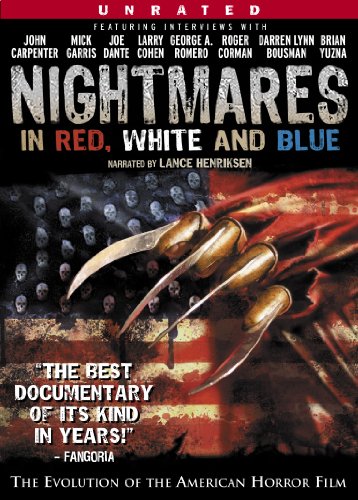
Nightmares in Red White and Blue

Have you ever recalled one of your dreams and really analyzed it? Did you gather all the elements and realize that they represented deeper desires and fears you have in the material world... and that you are really f'ed in the head?
We could say from looking at what America has produced in cinema, that America has it's own collective conciousness. America's hopes and fears are fairly obvious up front, but when America dreams and makes art, something very scary comes out.
Nightmares in Red, White and Blue is an excellent documentary for the horror buff, history buff, and anyone asking the question, "Why the heck are American's obsessed with violence?"
If you enjoyed Bravo's The 100 Scariest Movie Moments (one of my top favorite countdown shows!) you will love Nightmares. You see the evolution of the horror movie genre shaped by social upheavals, changes in standards, politics, and most importantly, war.

Psychologically, we see the movie monsters alter to society's changing fears.  In 1910 Thomas Edison made a film adaptation of Mary Shelly's Frankenstien. A decent attempt at adapting a novel to film, it was a failure in theaters. It wasn't until after The Great War (WWI), when men were coming back injured and deformed like from no other war in history, film makers responded with the horror genre. They made their "monsters" mortal men who were hideous and cast aside by society, their ill fate causing them to be bitter and evil.

Nightmares explains how each decade's events, events that shapped the American psyche, were latently placed in horror movie topics, such as foreign evil-doers, body snatching, atomic insects, zombies, etc. Post Manson murders (and the end of the hippie era in general) gave way to extreme sexual blood lust movies, films about gangs of murderers senselessly terrorizing good people, and movies about the occult.

You thought that the b-movies, exploitation and slasher films were just mindless fun, but like the rings in a tree trunk, they reflect our own history back to us. So you sit down with America. Because you love America, you read between the lines of their dream journal and say,
"America, that's some heavy stuff. I think you might be paranoid about communists, have ptsd from the war, and were disenchanted by how the hippie movement went. Maybe you should talk to someone... Pft! Who am I kidding!? Repression is the backbone of these films. Get off on the blood and violence, or enjoy the allegory, who really cares? You got a good thing going America, don't change."

Tuesday, August 2, 2011

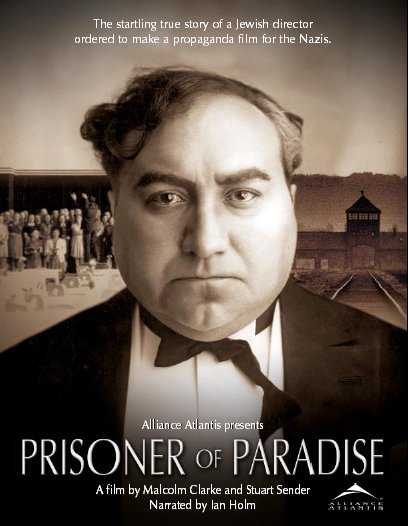
Prisoner of Paradise: The Making of a False Film

We have all seen our fair share of Holocaust films and documentaries.  Though many of the stories are comparable, the atrocities committed are never easy to swallow. When I saw the description of Prisoner of Paradise, it was apparent to me that I had never heard of anything like this. For starters, the title of the film, Prisoner of Paradise, is and unexpected title for a Holocaust documentary. Even facetiously, how could any part of this period be considered a paradise?
 The documentary follows Kurt Gerron, a Jewish German actor/entertainer from the 1920s and 30s, director in the 1940s. Gerron was captured like so many other Jewish talents, however, he was given a strange assignment while in captivity at the concentration camp, Theresienstadt.

Theresienstadt was the camp in which many Jewish actors, musicians, writers, and intellectuals were taken during the Holocaust. It was advertised as a more comfortable concentration camp for the privileged few. Not surprisingly, this was a lie. While the facilities were grand in appearance, they were altered for the Jewish guests. For extra money, a room with a view could be reserved for a prisoner, but they never taken to these better rooms. There was an auditorium that was available for the actors to put on performances, but the space could be used as a crypt at anytime. 
It was Gerron's job to use his skills as a director to make a propaganda film that would try and prove to the Danish Red Cross and the outside world that the Nazi camps could be cultural centers, and a happy place where Jews could live separately from everyone else.
You discover what Gerron's existence was before the Nazi take over, and how he desperately tried to hold onto his freedom, and then his life. His story is moving and unique. You see a man with a literal and metaphorical gun to his head, extracting every ounce hope to put on celluloid. Hope from men, women and children that are surrounded with death. Simply put, Prisoner of Paradise is the best Holocaust documentary I have ever seen.

Saturday, July 16, 2011

Care Package #1: Boyfriend

Today I'm going to try something new, and dedicate a blog post to someone I care about. We're going to call this one a Care Package. I hope to do more of this type of post in the future.
In this installment, the Care Package goes out to my boyfriend, comedian, Matt Aromando. Things about Matt you may or may not know: he likes Nirvana, Sailor Jerry Rum, and playing pinball. Here are three good documentaries that discuss all of these topics.

Watch here
Hori Smoku Sailor Jerry documents the life of Norman K. Collins aka Sailor Jerry, famed tattoo artist from the 1940's and 50's, and rum producer. Setting up shop in Hawaii, Collins pretty much brought tattooing to mainstream America. Tattoos went from being a criminal signature to a cute thing a young sailor could get as a souvenir while on tour. His tattoos were pretty risque for the time, but now they're a cool vintage statement. While his style might be considered a bit cutesy to current tattoo standards, Collins was no wuss. According to the film, Collins owned a pet monkey that he kept in his tattoo shop, which he personally tattooed. Watch the movie to find out what it said and... where he put it on the monkey. Also find out Ed Hardy's connection to the Sailor Jerry legacy, and how the title of this movie is a tad bit racist. (It's okay if you already got it).


Watch here
Hype! was directed in 1996 by Doug Pray, making this one an oldie but a goody. I don't know if it's just me, but I find older documentaries harder to take seriously because the topic could have advanced further past the date of the film. Like reading a science text book from the mid 1980s that doesn't have all the elements on the periodic table. However, this film benefits from being made right at the end, if not still during the grunge music craze. All of the opinions and knowledge are still fresh. This is truly an eye-opening documentation of how the genre began and how it got over-hyped. Of course Nirvana is a big part of this film, but it focuses on a lot of popular and not so popular grunge era bands from the Pacific Northwest.

Watch here
 Special When Lit discusses the history of a forgotten pastime, pinball machines. Why this documentary is important: you learn where in the world you can still play pinball, who has unreal amounts of pinball machines in their possession, where the Pinball Museum is located, the evolution of the machine, and the fact that pinball was illegal in America at one point. Also, if you've ever seen a Bally Total Fitness, and then got really confused when you saw the same logo on a pinball machine in a bar, you have made the correct connection, they are owned by the same company (whether that makes sense or not). Definitely watch if you like pinball, and it's still interesting even if you don't.   


I hope you all will enjoy this care package as much I think Matt will. Maybe some day if you get in my good graces, you too will find something special in your rss feed.

Friday, July 15, 2011

Rip! A Remix Manifesto

While looking for this poster I found Unseen Films

Ever think about what our culture will be like in 100 years? Will it be something we never dreamed of, something so new and original we couldn't even predict it in some kind of Epcot ride?  Or will it be a tired, reconstituted, cannibalized mess? Rip! A Remix Manifesto explains beautifully how our culture continues to evolve and rejuvenate. The main point is that we depend on the past to form the future, and that's the way it's always been whether your parents want to admit it or not.

Directed in 2009 by Brett Gaylor, Rip! explains how the current issues over ownership of our culture (copyright laws) is promoting stagnation. But the big to do over the laws is also causing a wave of rebellion that will be a sure fire way to keep the creative juices flowing. By following Napster, Girl Talk, Air Pirates, and many more artists involved in music and or video, we see how they are misunderstood as thieves and hacks.   
Shot from Rip! A Remix Manifesto

For me, this film was great because I got to see how Girl Talk makes his music. His concerts look like a religious ceremony where the religion is about worshiping the structure of modern songs, and understanding their harmony... and dancing like a mother.

Also the graphics in this documentary are excellent! They simultaneously present facts and entertain. There are several scenes where a point is powerfully made with artful video time lines.  Rip!'s plot has a lot to do with modern music file sharing, but it also makes it's point about the pattern of recycling culture throughout history by presenting examples from decades ago.  While The Rolling Stones sue the pants off of The Verve for sampling their song, you see that the Stones actually weren't being very original themselves.
This documentary goes at the top of my favorites. The things that are said are extremely important for all of us to hear as a society. If you ever wanted to do something creative, watch Rip! A Remix Manifesto.